Commonwealth Bank & Trust

Broken Sidewalk Archives

Posts Tagged Sustainable Architecture

If you can't find what you are looking for, try searching for it below:


Tag Archives: Sustainable Architecture

Below are listed the articles tagged Sustainable Architecture
  • 19 / Jan
    2010

Green Architecture Planned At Bardstown Road Car Wash Site

Rendering of the Highland Green Building (Courtesy Design Plus)

Rendering of the Highland Green Building (Courtesy Design Plus)


Bardstown Road is gettings its own “green building.”  A new two-and-a-half story mixed-use structure is proposed for the site of of a former car wash on the corner of Bardstown Road and Edgeland Avenue and will contain a Highland Cleaners, retail space, and two condos.


Michael Jones, owner of Highland Cleaners and Doric Real Estate, hopes to set a precedent for sustainable architecture on the Bardstown Road corridor with his structure dubbed the Highland Green Building.  Among the green amenities planned are passive and active solar technologies, a green roof, pervious concrete, geothermal heating and cooling, and even a greenhouse above the garage that will be able to grow food year round.  Jones is also planning a sidewalk educational feature with a computer screen showing how the green technology works.


Two lofted condos are planned above the first floor retail space.  One retail space will include a Highland Dry Cleaners drop off location.  No dry cleaning will be handled on site due to the chemicals involved in the process.


The proposed structure was designed by Design Plus Architecture of Bardstown Road who also recently designed the Bardstown-Eastern Building housing a Heine Brothers Coffee Shop just down the street.  John Warmack, principal at Design Plus, says the building will be a little more modern than the B-E Building but will still blend with the neighborhood through scale and material.  The building facade will primarily be brick.


A drive-through for Highland Cleaners is planned despite the green nature of the building in a walkable area, but Jones says it’s an important part of the dry-cleaning business and customers demand ease of access.  Warmack says the drive-through and parking were placed at the back of the narrow site to minimize its appearance on Bardstown Road.


Construction could start as early as next month, but Doric Real Estate is still in the process of acquiring permits.  The project has already been through the Bardstown Road Overlay Distrist and a demolition permit has already been approved for the old car wash and site clearance should occur soon.


Jones and Warmack both agree tearing down the car wash and building an urban edge along the street will fundamentally improve the streetscape and create a synergy with other businesses in the area.


Click through for site photos, a map, and another rendering.

  • 08 / Dec
    2009

Norton Commons Building Awarded LEED Gold Certification

CMTA Building Awarded LEED Gold (Courtesy CMTA)

CMTA Building Awarded LEED Gold (Courtesy CMTA)


An office building in Norton Commons has been awarded LEED Gold certification indicating the building has achieved the second highest level of sustainability as tracked by the United States Green Building Council.  Located at 10411 Meeting Street, CMTA Engineering Consultants has been a leader in sustainable design and now has an exemplary building to demonstrate their commitment to green design.


CMTA’s building achieved certification in late October and received 50 LEED points, only two shy of the highest Platinum level.  After going through the certification process, CMTA says they have the experience and knowledge to achieve Platinum status on future projects.


Some of the green features of the two-story, 20,000 square foot building include sun shades on the buildings facade, flat fabric thin film solar panels on the building’s white roof (see photo after the click), and Solar Tube interior lighting devices.  Solar power is expected to account for 10 to 15 percent of the structure’s annual energy usage.  The structure was built with insulated concrete forms (ICFs) in which concrete is poured into insulating Styrofoam forms.  Geothermal heating and cooling has been incorporated as well as a custom designed LED lighting scheme, although most of the light used in the building is natural light.


The structure is located near the Norton Commons town center and has been designed to reflect local architecture from the 19th century.  Broken into three differentiated components, the building contains three facades reflecting two townhouses and a commercial building and represents the first commercial building in Norton Commons to include sustainable concepts.


CMTA hopes to use the building to test the efficiency and effectiveness of many of the systems installed in the building to create better sustainable buildings in the future.


[ Editor's Note:  Updated the total number of LEED v2.2 points earned by the project (12.9.2009). ]


Click through for a couple more photos.

  • 03 / Aug
    2009

What Makes The Green Building Green

The Green Building (BS File Photo)

The Green Building (BS File Photo)


The Green Building on East Market Street in the newly named NuLu district has been garnering quite a bit of news coverage lately, much of it detailing what makes The Green Building green.  The 110-year-old structure is in the running for LEED Platinum certification, and is filled to the brim with an assortment of sustainable technologies.  Here’s a wrap-up of the coverage by architects (fer) Studio and owner Gill Holland.


Architect Doug Pierson, AIA provides a detailed account of the history of the project and scrutinizes the details that make the project green.  A longtime friend of Gill Holland, Pierson recalls that the building grew out of a desire to bring green building awareness to Louisville by implementing LEED Certification.


“The road to NuLu, as the area is now called, has been tested by a continuous series of challenges during the design and construction process: 


“Flexible design program: The Green Building is a working model for active collaboration between architect, owner and builder to weave the integration of new technologies (a moving target) into the design program (traditionally a static element of the process). To reconcile these different approaches, the program was left intentionally loose at the onset to allow for the participation of experts in various fields as the project developed. Initial design schemes were built as a physical model by (fer) studio to test the dual design approach of engaging spaces and sound sustainable design principles. The model was then brought to the site as a design tool. As engineers became involved, the team navigated through design shifts that would allow the overall intent to remain intact while incorporating new and efficient systems into the overall approach. As a result, the team was able to absorb and incorporate new construction methods and systems such as geothermal wells, energy recovery ventilation and mass energy storage, all while staying in step with the overall design intent. 


“Cost controls: Also a constant challenge was cost escalation. Each time we added systems, we added cost and scope. In order to mitigate the increase, we constantly balanced the design program through a give-and-take process. In order to incorporate new systems such as geothermal wells, we revisited the design scope to search for areas where we could reduce scope and maintain the overall design intent. 


“LEED tracking: The third challenge in the project was the need for sensibility at the site for an array of conservation and tracking efforts required by the project team. Resourceful and time-consuming efforts were required to substantially minimize landfill diversion during demolition. All old timber members were inventoried and allocated for future use in the design integration process. Also, close scrutiny was required for all materials and resources specified in the project. For example, management of the changing landscape of Forest Stewardship Council (FSC) certified wood was constantly required since suppliers continually shifted the percentage and availability of the certified wood within their product (e.g. plywood) without notice.”


Pierson recounts every detail tht gives the building its iconic name including its vast recycling and reuse program.  Among other things, one door, 72 light fixtures, and 17 hinges were donated for reuse from The Green Building.  New materials in the structure are made of many recycled materials and a range of design techniques and technologies, old and new, help to complete the process.


Natural daylighting, energy efficiency, 81 solar panels, geothermal heat pumps, and, of course, a green roof all come into play.  Pierson notes that “The Green Building exceeds by a remarkable 65 percent all energy efficiency standards set by Kentucky Energy Code.”  There’s plenty of additional information about the project including more specifics on sustainable techniques in the full article; it’s well worth reading.


Doug Pierson and business partner Christopher Mercier also sit down for a telephone interview for EcoFactory, where many of the green principles are detailed again.  The architects also discuss the sensitivity of the building to its historic context and the future prospects for sustainable architecture in the United States.  Listen to the interview over here.


Gill Holland, film producer and owner of The Green Building, has also written an in-depth tome on his project for the University of Louisville’s Sustain Magazine (it’s not online yet).  Gill and his wife Augusta knew they “wanted to go for official LEED certification.  We knew we had lots of green ideas, but were just learning about this certification.  We figured it was like dieting:  if one is going to diet, one should not be scared to get on the scale.”  The developers were “green” with inexperience before they were “green” with sustainability.  Their architects helped clarify their vision along the way.


“On one level we were like the crystal meth addicts who, upon seeing an empty house or a house for sale, break in and strip out the copper wiring to re-sell.  Until the economic meltdown, copper was trading at high rates.  On the way to work I even started noticing manhole covers missing…


“It’s not just the classic “reduce, reuse, recycle” at play here;
 it’s also how much can you divert from going to the landfill. The easy part is dedicating an area in the finished building as a recycling center;  the hard part is demolishing responsibly.


“Normally when you demo a building, you take some sledgehammers and just trash it, fill up the dumpster, take it to the landfill. It takes a lot of time to demolish a building in an environmentally friendly manner and time is money. Land is finite, and more and more humans live on it.  For LEED, you have to weigh all the debris, and a percentage of its  total weight and physical space must not go in the landfill.”


Once construction actually began, Gill recounts how thinking sustainably guides the building.  Locally produced building materials were used to cut down on the carbon footprint associated with transport; he notes a pleasant side effect is stimulating the local economy.  Wood products were harvested from sustainably managed forests and gypsum board contains 40% recycled materials.  Indoor air quality also plays an important role as we spend so much of our time inside where air quality can be three times worse than outside.  Paints and finished that don’t “off-gas” pollutants that can build up in the human blood stream were used throughout the building.


Some of these techniques cost a little more, but Gill looks at it as training new skills for local construction workers who “got educated as to where to buy these products, what to look out for in these products, and why these things are important.
 They will pass this information along and take it to their next jobs.”


One of the most dramatic features of The Green Building are its 81 solar panels on the roof.  When combined with skylights for natural lighting and a green roof to capture rainwater runoff and reduce heat gain, The Green Building’s roof is a tour-de-force in sustainable roof technology.  Gill describes the solar panels:


“Solar panels are made out of photovoltaic cells.  We spent about $112,000 on the 81 panels we use which provide almost fifteen Kilowatt/hours on sunny days.  That is enough to power the building so on good days, we are “off the grid” metaphorically (at present we still have to go through the grid).  We do not generate enough energy to store and even if we did, batteries are not inherently “green” (though can be effective in remote areas).  We do not yet have net metering on our building in Louisville so cannot yet sell any excess back to the electrical company. Kentucky, however, does allow this option and the paperwork is underway to accomplish it.  Doing the math based on the average number of sunny days in Kentucky and the present cost of electricity, we should recoup in about sixteen years and then have a fixed asset that gives us a 2% return (which based on the stock market’s performance in 2008 is very attractive!)  If one assumes the costs of energy will double every five years as it seems to have historically, the time to recoup drops significantly and the return increases…


“The three DC-AC converters placed on the wall below the solar paneled roof are crowd pleasers.  They count the amount of CO2 saved from entering the atmosphere due to the panels.  So far, taking the less-sunny fall months as an average, we are saving 30,000 pounds of CO2 a month.  If taxing carbon emissions becomes a reality, we will quickly make back our solar investments in savings!”


There’s much more detail in the article covering everything from water efficiency and landscape architecture to paving and special concrete blocks made from the byproducts of iron and coal production.  In the end, The Green Building as a veritable living laboratory of sustainable design that serves well to teach and promote green building in Louisville.  We’ll let you know when the article goes online so you can read the rest.


  • 06 / Jul
    2009

Sullivan University Adds Green Curriculum In A Green Building

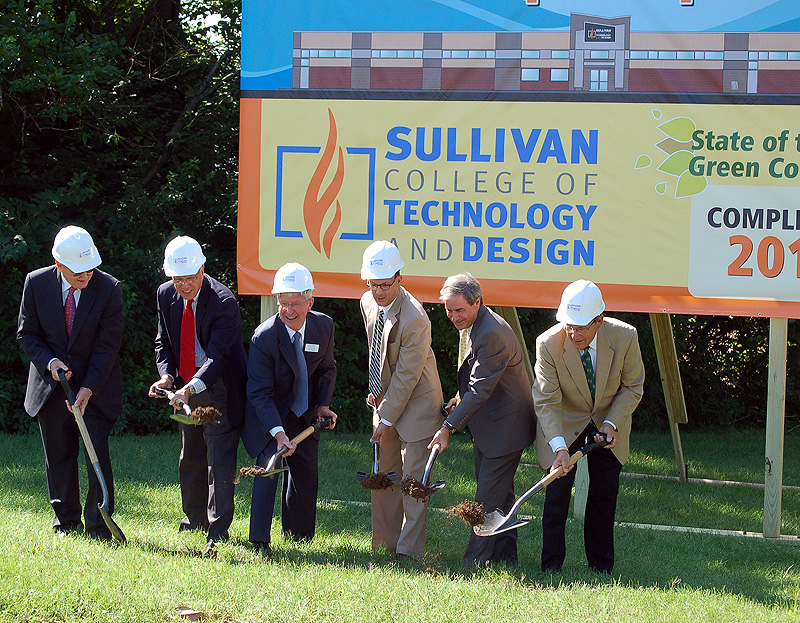
Sullivan University breaks ground on new green building (courtesy Sullivan University)

Sullivan University breaks ground on new green building (courtesy Sullivan University)


Sullivan University announced last Monday that it has formally changed the name of the Louisville Technical Institute to the Sullivan College of Technology & Design.  To celebrate the change, officials broke ground on a new 12,000 square foot building that is expected to receive LEED Certification for green building.


The new SCTD Building will open in 2010 and serve as a living laboratory to demonstrate the green technologies housed within.  Glenn Sullivan, president of the University, describes some of the changes in store:


“Other exciting changes at SCTD is the addition of the new HVAC-R (Heating, Ventilation, Air Conditioning – Refrigeration) program which will begin our foray into “Green Technology” programs.  We believe that there is a lot of opportunity in “Going Green” and our goal is to be a regional leader in providing training for this “green-collared” energy management and auditing career field.  Also, one of the goals at SCT&D is to expand our current programs and offer more Bachelor’s Degrees. Just last week, we received approval to offer a Bachelor’s in Graphic Design.”


Glenn Sullivan recently named to the Kentucky Chapter of the USGBC which oversees the LEED program, so it’s natural that the University should take a lead in sustainability.  The new building occupies the former site of LTI and is expected to take about six months for construction.  Environmentally friendly building materials will be used to build the structure.


Click through for more photos of the groundbreaking ceremony.

  • 05 / Mar
    2009

SoBro Pushing Eastward: Scholar House Plans Detailed

Downtown Scholar House (rendering by Girdler Group & Gil Stein Architects)

Downtown Scholar House (rendering by Girdler Group & Gil Stein Architects)


Today, the Family Scholar House announced plans for a new $10 million campus on the corner of First Street and Breckinridge Street in the SoBro neighborhood.  Officially known as the Downtown Scholar House, the 54 unit facility will provide supportive housing and educational programs for single-parent students.  The location at the site of the former Jim Cooke Buick and current BMW Motorcycle and Vespa showroom was chosen for its proximity to Spalding University, the Jefferson Community and Technical College, and the University of Louisville.


The Downtown Scholar House represents the second campus for the Family Scholar House, formerly known as Project Women.  The first 56 apartment facility is located adjacent to the University of Louisville’s Belknap Campus.  Demand is high for apartments in the program.  Currently, 350 families are on the waiting list, and the new campus should help ease the space crunch.  The Family Scholar House aims to support the educational aspirations of single-parent families and to help foster college education to create valuable members of the community.


Two buildings currently on the project site will be renovated: a historic brick structure that once house the Filson Club will be transformed into a Scholar House community center and a former hotel owned by the city will serve as apartments.  Two new structures on the corner will lend an urban edge to the site and take on the massing of townhomes.  The design work was handled by the Girdler Group of St. Matthews and Gil Stein Architects. The Marian Development Group is serving as developer.


Like it’s predecessor the Louisville Scholar House, the campus is designed to foster a supportive community within and takes on a sort of cloistered form with balconies overlooking the parking lot and play area.  It’s also welcome news that 54 new families will be calling SoBro home.  The Family Scholar House sees their approach as a local method of stimulating the economy by supporting local families.


Sustainability also plays a key role in the design.  One existing building is slated for a green, vegetated roof and the new structures will be built of modular panels built off-site to reduce waste and speed construction time.  Energy efficiency will also play a key role in the new building and 2×6 stud walls will provide for extra insulation.  The western portion of the nearly 2-acre Jim Cooke Buick property won’t be immediate built upon but could see a future addition.


Financing for the project in part comes from $7.73 million in tax credits and $200,000 from the state’s affordable housing fund.  Ground is expected to be broken in a couple of months, so this site should quickly be transformed from a one-story showroom and corner parking lot into three-stories of townhouse apartments.


Click through for site photos and more renderings.

  • 04 / Mar
    2009

Snapshot: Clinical & Translational Research Building

Clinical & Translational Research Building

Clinical & Translational Research Building


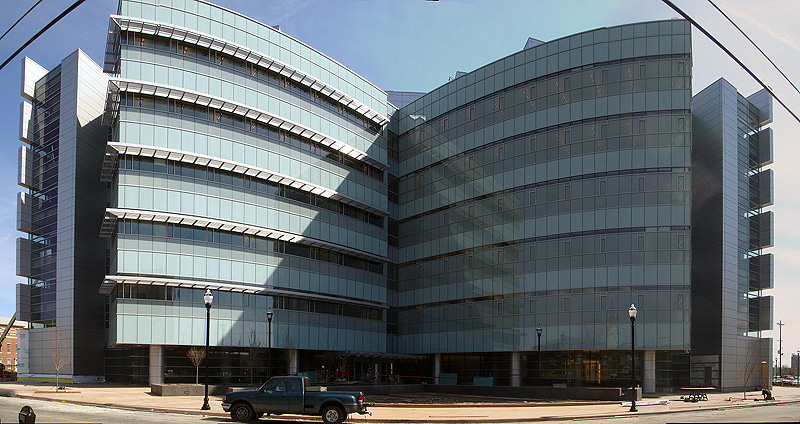
Yesterday the construction fence surrounding the University of Louisville’s Clinical & Translational Research Building came down.  The new $143.1 million building on the corner of Hancock Street and Muhammad Ali Boulevard won’t open until July, but much of the exterior site work is already complete.  Workers were seen installing a glass canopy overhanging the building’s main entrance as the fence was hauled away.  Today, crews were removing the construction-worn asphalt on surrounding streets in preparation for repaving.  Signs noting “Sidewalk Closed” were still placed on site, so the plaza might not be open for a little longer.  The Clinical & Translational Research Building’s architectural services were provided by Arrasmith, Judd, Rapp, Chovan, Inc. of West Main Street and SmithGroup of Detroit.


Click through for a few more photos.

  • 02 / Mar
    2009

New Mixed-Use Project Aims To Revitalize Butchertown

Butchertown Pointe on Washington Street

Butchertown Pointe on Washington Street


A long boarded up industrial property on Washington Street just west of Cabel Street in Butchertown is set to become a new mixed-use creative hub for the historic neighborhood.  The project has been dubbed Butchertown Pointe to recall the memory of the old Pointe neighborhood destroyed in the 1937 flood that sat just north of the site.  When complete this summer, the one-story brick and timber building will house 35,000 to 40,000 square feet of much needed commercial and retail space in the predominantly residential neighborhood.


Butchertown Pointe is being developed by Ron & Aaron Tasman and Brian Scalabrine of Tasman Capital who were drawn to the Butchertown neighborhood by its potential as a vibrant urban neighborhood.  Ron and Brian along with associate Gene Rosenstein have already had great success redeveloping a large stretch of Baxter Avenue that’s home to many of Louisville’s favorite establishments such as Wick’s Pizza and Nios nightclub.  Gene has also been instrumental in the groups Butchertown project.  Brian Scalabrine, who plays for the Boston Celtics, has been impressed with Louisville’s strong neighborhoods and brings a unique perspective to the redevelopment with ideas from Boston and major cities on the West Coast.  The group thinks Louisville has as much potential as any major city, especially with its strong creative community.


Their new project hopes to tap into that creative scene to establish a vibrancy at Butchertown Pointe and the neighborhood beyond.  Already, several leases have been signed with creative and graphic firms for the new space and the building’s design is meant to foster collaboration and “coworking” throughout.  A grand 21 foot wide corridor forms the entrance of Butchertown Pointe and serves as a mixing space inside.  The wide open interior spaces, high ceilings, and massive skylights help create an open and modern feeling in the historic structure.  The redevelopment project retrofits the 19th century to create a high-tech office environment and could include a small theater and spaces for events.  The project is being designed by Potter & Associates of Main Street and the renderings were produced by Visual Scientists of Highland Avenue.


Click through to read more and for more photos and interior renderings.

  • 27 / Feb
    2009

Limerick Seeing Rebirth One Building At A Time

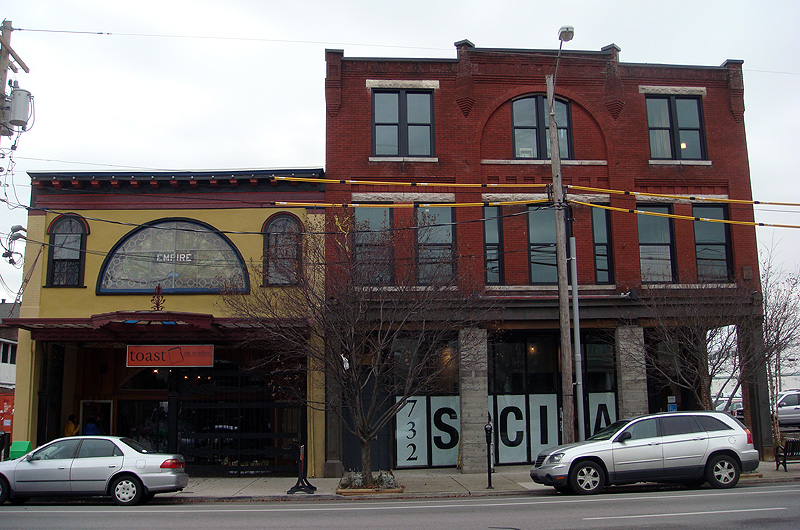
Commercial building under renovation

Commercial building under renovation


A group of four investors has been quietly working to revitalize the Limerick neighborhood adjacent to Old Louisville.  Shine Properties has already finished renovating two historic shotgun houses on Seventh Street and Zane Street and is now tackling its largest project yet: a two-story commercial building on the corner of Seventh Street and St. Catherine Street.


The brick structure had been in terrible shape before the investors came across it.  Water damage had weakened the interior walls, and some of the floor had to be replaced from rot.  The exterior of the will be completely tuck-pointed and the commercial store-front will be restored to its original configuration.  The building dates to the 1800s and was reportedly once a bread bakery.  Plans are evolving, but the ground floor could again contain retail space and the upper floor could possibly be a two-bedroom apartment or an office.


Shine Properties consists of real estate agent Matthew Gilles, architect Mosley Putney, Gregg Rochmann, and Jonathan Bevan.  Mosley has designed the group’s renovations so far.  Gregg and Jonathan moved to Louisville only two years ago from the northeast after seeing the potential of the city first hand.  Shine’s goal right now it to revitalize Limerick and bring back a community to an often overlooked historic neighborhood.


Matt Gilles explained that many derelict buildings in the area are in desperate need of work.  Sitting boarded up, they serve as “rat traps and fire hazards”, but purchasing them for renovation or redevelopment is often hindered by complicated deed structures.  Upon finding a now renovated shotgun house on Seventh Street, Matt knew he wanted the house before even seeing the interior.  He says working with properties in such terrible shape from the outset can be frustrating, but rebuilding Limerick is worth it.


The team doesn’t want to work on the neighborhood alone, either.  Shine Properties hopes to bring Limerick to a tipping point where additional investment from others, both developers and individuals, can become commonplace.  They also hope to bring the highest quality product possible to the area.  Matt says as a real estate agent, utility bills are of top priority to buyers and renters alike.  The two houses already rehabbed include energy efficient systems like tankless hot water heaters, bio-foam insulation in the walls, and 14″ of ceiling insulation.  These extras cost more, but are worth it in the long run, Matt says.


Limerick is lucky to have found a development team so dedicated to the neighborhood.  Shine Properties plans to be there for the long haul, too, and see the neighborhood into better times.  This involves more than just fixing up abandoned buildings.  One simple way the team contributes to the community beyond renovation work is keeping the area clean.  Workers pick up not just their own trash but any litter they see around their project.  Shine Properties knows that neighborhoods trash reflects badly upon everyone and wants to create a clean and safe area for their projects.


Click through for more photos inside and out and before renovation started.

Page 1 of 212

ADVERTISEMENT

  • Archives

  • Categories