Broken Sidewalk Archives
If you can't find what you are looking for, try searching for it below:
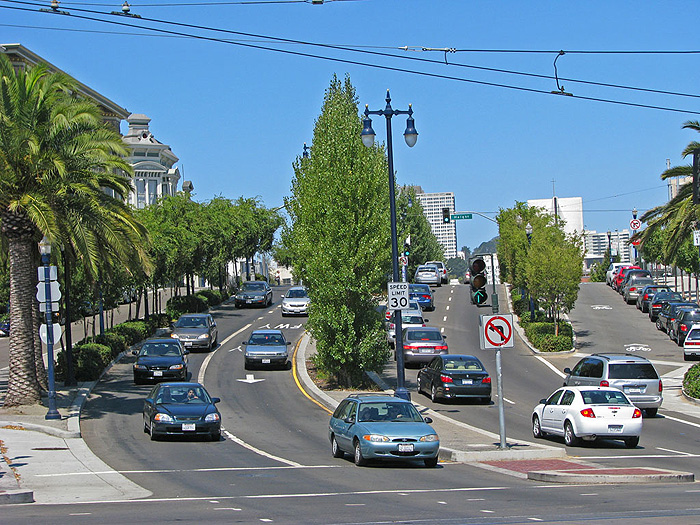
A little while back, I showed you West Street in New York that was once an elevated highway on the Hudson River. Here’s another example of a highway removal project in San Francisco where the elevated Central Freeway was torn down to create Octavia Boulevard. Just one more instance showing the benefits of highway removal such as proposed by the 8664.org campaign.
It’s been a while since I dissected the unpublicized and unknown components of the Ohio River Bridges Project (the really scary stuff is over here). There are a couple more over at 8664.org – here and here. This time, let’s take a look at how Interstate 65 interfaces with Southern Indiana between Clarksville and Jeffersonville.
First, take a look at the Second Street Bridge. Today, the bridge terminates at Court Avenue (the bottom arrow). After the Bridges Project (ORBP), however, you will be forced to take an off-ramp from the bridge which deposits you on an extended Sixth Street in Jeffersonville (the top arrow).
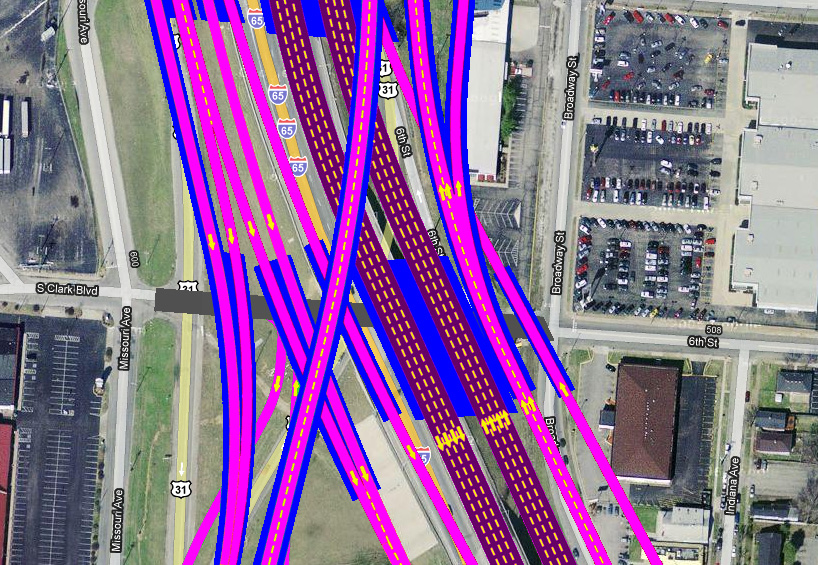
And, you will notice, when you get to the end, you’re buried under sixteen lanes of highway – and a double decker highway at that. No better way than to say “Welcome to the Sunny Side” than to be under so much concrete. The map below shows the situation in more detail. You can clearly see the flyover ramp that will be soaring at least 40 feet above the sidewalk level.
What’s more troubling, however, is that the Second Street Bridge has effectively been turned into an off-ramp for Interstate 65. If you look at the maps, it ceases to be a local access bridge and instead ties directly into the highway.
Next, imagine motorists barreling along an open straight-away at Interstate speeds and then onto the Second Street Bridge. There’s already a significant speeding problem already today and this is simply going to make it worse.
In the diagram below, the arrow is pointing to the merging area where the on-ramp from the street grid attaches to the bridge. Not only will this be dangerous for motorists, but potentially deadly for cyclists. The Second Street Bridge will turn into an expressway, and if the I-65 bridge is tolled and the 2nd Street bridge isn’t, you can imagine the problems that will ensue.
Next, lets take a closer look at what’s actually happening to one our most historic bridges: it’s being destroyed. It’s a little hard to see, but below is the current footprint of the Second Street Bridge overlaid on top of the ORBP plan. The arrow is pointing to two yellow dots representing the limestone pylons marking the entrance to the bridge.
Notice that the footprint of the now-a-highway-off-ramp bridge is over twice as wide as the existing bridge. What’s going to happen to the carved limestone pylons and the limestone guard rails by the sidewalk? And look at all the landscaped area to the west of the bridge that will be destroyed.
Everyone should by now be familiar with how bad the Spaghetti Junction is going to be at 24-or-so lanes running through the core of the city. But check out how badly Interstate 65 is going to tear apart Southern Indiana. Below is a larger map showing the highway headed for Louisville.
Those are lane counts that do not include space for shoulders or wasted swaths of land between ramps. Does Jeffersonville really need a 19-lane highway splitting it off from Clarksville?
When it comes down to it, the vast majority of the ORBP was never explained to the public and no one has any idea of how destructive this thing really is going to be. No one knows the extent to which it will change everything from Butchertown, to Slugger Field, to the Second Street Bridge.
Do we really want to cross the Second Street Bridge and land under 16 lanes of tangled highway? Do we really want to make cycling to Southern Indiana even more dangerous than it is today? Do we really want the Second Street Bridge to be an off-ramp for Interstate 65 and do we want to destroy the historic detailing that makes the bridge beautiful? How many lanes is enough?
This is out of control.
It’s been a little while since we have talked about that slow moving disaster ready to stamp out so much progress being made in Louisville. I am, of course, describing the Ohio River Bridges Project. In an effort to bring Broken Sidewalk up to date with what’s been going on, here’s a rundown of a few major events. Did I miss anything?
“I began going to the public bridge meetings with Daniel Boone. Everyone was very nice; we were asked to vote on the designs we liked best, and then 14 bi-state officials and politicians locked themselves in a room and made the final decisions. In Indiana, developers were selling land and houses to people the developers knew would be in the path of the bridge. In Kentucky, one of the main arguments against the bridge became that it would help create jobs in Indiana — a fine example of upscale regional thinking. Meanwhile, some of the bridge-path land the environmentalists were supposed to be saving was being eaten up with new houses — many of them oversized, hey-look-at-me, energy-eating monstrosities.”
“Most discouraging is the nonsense spouted by some of the champions of these projects. Senator Ed Charbonneau (Repub) for example called the bill “the jobs bill of this session” claiming it will “create 30,000 jobs.”
“Such enthusiasm is touching, but road projects are not to “create jobs.” If they were we’d ban all machinery and have all the work done with picks and shovels.
“These projects are to serve motorists by saving them time and travel expense and they have to be judged by the financial viability – whether they can attract sufficient in toll payments by motorists to support the costs – which have to minimized with the optimum mix of labor and equipment, not with “job creation” in mind.”
Steve Wiser, a local architect, historian, and occasional contributor to Broken Sidewalk, has been tweaking his proposal for a solution to the Ohio River Bridges Project that involves local access bridges as opposed to Interstate highway bridges (that we first published last April). He will be presenting his ideas tomorrow (Saturday, March 6) at Destinations Booksellers – Dueling Grounds Cafe at 604 East Spring Street in New Albany.
Here’s some information about the event:
As the prospect of tolls on the Kentucky-Indiana Ohio River Bridges edges closer, one local design professional is proposing a more rational and less costly solution to the crossriver commute.
Architect Steve Wiser says new local access bridges at several points along the river in Clark, Floyd, and Jefferson counties would eliminate congestion and perhaps forestall the dislocations and expense of what’s being called the Ohio River Bridges Project. With a bi-state authority just beginning its deliberations, Wiser says now is the time to explore the alternatives.
A cursory examination of readily available data shows that Indiana residents would be paying a disproportionate share of tolls or user fees. More Hoosiers work in Kentucky than Kentuckians who work in Indiana.
The toll-free local access plan is roughly outlines in the diagram above and begins with the construction of the East End Bridge as planned. Instead of the extremely expensive Downtown portion of the bridges project (including the $2 Billion junction overhaul), Wiser proposes two local access bridges – one from Jefferson to Floyd County, Indiana and one to Clark County. A busway would tie everything together.
Here’s Steve Wiser’s synopsis of the plan titled Boiling a Frog: Time to ‘Jump’ to a Toll-Free Better Bridge Solution:
Have we lost all perspective on how this will negatively harm our community’s growth? This drastic situation did not occur overnight. It’s been a slow, steady 50 year process that has resulted in this worst case scenario.
Costs have skyrocketed almost 2,000 percent since the initial projection of $200 million was made for the east end bridge in 1990. The tunnel alone has soared 300% in just the last three years.
If today, without all this past history, a task force recommended a $4.1 billion dollar, two bridge, massive overhaul of spaghetti junction, toll-funded proposal, both governors would respond: ‘are you NUTS!?! You want to divide our two states with tolls? Go back and find a more realistic solution!’
So, its surprising no one in a leadership position says ‘whoa, let’s take a step back. Is this really the best way to create cross-river connections?’
No one wants any more delays or increased costs. In fact, folks want the bridges built faster, at a lower cost, with no tolls. The reason given for this lock-step approach to this bewildering scheme is that it’s the only solution both states can agree on. And, the ‘Record of Decision’ (ROD) by the federal highway department can’t be revised.
Well, a simple ‘Google’ search reveals that changes happen on RODs all the time, so that doesn’t seem to be a major roadblock. Certainly the costs and schedule for this project have constantly spiraled upward without any leader complaining that these ballooning excesses are harmful to the project’s implementation.
As to the only bi-state solution, well, Kentucky and Indiana work together routinely, without such drama, tolls, or complicated process, to build bridges across the Ohio River such as the recent Owensboro Natcher Bridge, and the upcoming Madison, Indiana Bridge.
So, in taking a cue from Gov. Daniels charge to the bridge authority to consider every option and approach this task in a business-like manner, and not government-like, I submit my proposal:
- Build the east end bridge without the tunnel
- Instead of the tunnel, relocate the Drumanard mansion, recreating the landscape, as the ‘Olmsted Interpretative Center’
- Build two new ‘local-access’ bridges adjacent to the Clark and K & I bridges
- Build new access connector for I-71 and I-64 for the east downtown-med center-arena-waterfront districts
- Build an elevated ‘busway’ along the waterfront connecting these two new local-access bridges
My guestimate for this proposal would cost $1.4 billion, saving $2.7 billion (based on ORBP figures). It would spur economic development in west Louisville, east downtown, and southern Indiana.
This is doable within a 5 year timeframe, and without tolls. It also lessens the environmental footprint, and thus avoids an ROD complication.
To continue on the current path will put at a great disadvantage our logisticsbased economy and overall quality of life.
Most are familiar with the tale of ‘how to boil a frog’: slowly turn up the heat so the frog does not jump out. Hopefully, there is still time to alter this growththreatening, extreme makeover and ‘jump out’ to a more reasonable, beneficial bridge solution which makes our metro community a much better place in which to live.
Check out Steve’s entire proposal at his web site Wiser Designs.
Here’s a well put together video from GOOD Magazine about pushing innovation in our cities. Plenty of good ideas from around the world covering Bus Rapid Transit (BRT), to biking, to the environmental benefits of removing urban freeways (8664 anyone?). Well worth a watch. Hat tip to @urbanophile.
The Courier-Journal just broke the news that River Fields, a group opposing the East End Bridge in favor of a Downtown-only option, has co-filed a lawsuit with the National Trust for Historic Preservation claiming that Federal approval of the Ohio River Bridges Project in the Record of Decision is not valid. Here’s a quote from the C-J:
“The groups claim the federal government didn’t justify its selection of a two-bridge project; relied on misleading information on the need for an eastern Jefferson County bridge; failed to adequately consider possible impacts, such as construction delays and the effects on nearby historic properties; and failed to prepare an updated environmental report.
…
“And it alleges that the government’s approval of the project and the eastern bridge route was “arbitrary, capricious, an abuse of discretion” and in violation of the federal Department of Transportation Act.”
Can’t say this move was completely unexpected, but it certainly came down to the wire with only two days remaining to file suit. We’ll have more on the unfolding story later and what it means for the 8664.org proposal and the Ohio River Bridges Project overall.
One day Louisville will collectively look up on an unencumbered Great Lawn and think, “Well, that was obvious.” I’m, of course, talking about the 8664.org plan to re-route Interstate 64 out of Downtown and over a new East End Bridge, eliminating the need for that city-death-tangle we hopefully will never know as the expanded Spaghetti Junction and a second Downtown I-65 bridge. Instead, we’ll have more park space, a revitalizing West End, and a beautiful, pedestrian friendly urban boulevard. (Read the rest of the 8664.org coverage from Broken Sidewalk.)
Richard Vanderbilt of How We Drive points us to a Harvard University researcher, Lant Pritchett of the Kennedy School of Government, who has theorized the progression of once controversial ideas. Pritchett suggests that any “big idea” passes through four stages of social acceptance: silly, controversial, progressive, then obvious. While not a linear progression, many social conditions followed this pattern from slavery to a woman’s right to vote.
Where are we on this scale in Louisville regarding the 8664.org plan? It looks like the city overall is hovering somewhere between “controversial” and “progressive”, despite many supporters who are already firmly planted in the “obvious” range. The reasons I believe the 8664.org plan is obvious have already been detailed at length in previous coverage, but many in the city including some elected officials, can’t see the facts presented from a multitude of fronts. That’s why we still must press our leaders to take a stand on the most important issue facing Louisville today. Call them and e.mail them and talk to your friends and neighbors so one day we all will see it was obvious all along.
Per Tom Vanderbilt about New York (but also about Louisville):
“‘Kill the street,’ the Modernist architect Le Corbusier once declared in a manifesto for a utopian city built around the car. Generations of traffic engineers did their best to oblige. But the street is coming back in New York–the street built for many users–and someday, if not quite today, it won’t seem silly, controversial or even progressive. It will just seem obvious.”
[ Photo Credit: hock / behance network. Used under a Creative Commons BY-NC-ND-3.0 license. ]
The Ohio River Bridges Project could threaten smaller transportation projects around the Louisville region. The C-J reported today that because there’s no financing plan for the $4.1 Billion fiasco, the Federal government could freeze important short-term transportation projects. A December deadline has been imposed to settle on a financing plan.
“Four years ago, officials expected that the states’ federal gasoline tax revenue would be enough to cover the cost, which was estimated at $1.4 billion.
“But now that the project has climbed to $4.1 billion, Kentucky and Indiana are looking for more money — possibly including tolls — and the federal government wants details.
…
“The government requires all federally financed transportation projects to have clear sources of funding to keep unrealistic projects from tying up money.”
We’ve known that the demands of financing this mega-project are far greater than the expected return. For merely half the price, the 8664.org plan solves the same transportation problem without requiring tolls or the destruction of Downtown Louisville. It’s definitely not too late to fix our transportation issues in a responsible way. Perhaps the Feds will finally realize that the Spaghetti Junction-two-bridge solution is as “unrealistic” as many have know for so long.