Broken Sidewalk Archives
If you can't find what you are looking for, try searching for it below:
A large building on the corner of Quadrant and Stevens Avenues in the Deer Park neighborhood could soon make way for a surface level parking lot. A tipster recently spotted an Intent to Demolish sign on the oldest corner of the Highlands Nursing Home and Rehab Center, formerly the King’s Daughters and Sons Home, at 1705 Stevens Ave.
May is National Preservation Month and it appears Louisville is celebrating with a dozen attempts to tear down historic buildings. The latest is an historic mansion perched atop a bluff overlooking the Ohio River. Dating to 1830, the Rock Hill mansion (aka the Callahan House) at 405 Mockingbird Valley Road now finds itself in the crosshairs of the wrecking ball.
The original portion of the house was built in 1830 and later rebuilt in 1885 after a fire. A dramatic front porch with Doric columns faces the river. It sits on a 20-acre compound with several ancillary buildings including an old school house and a cemetery.
According to a C-J report, the owners say a rear wall has shifted and become unstable prompting the demolition request. The owners claim it would cost “hundreds of thousands of dollars” to rebuild the wall and fix the house, money they aren’t prepared to invest.
Neighborhood groups and preservationists have mounted a campaign to declare the mansion a Local Landmark, but time is running out fast. A 30-day demolition moratorium expires today, but the owners say they don’t plan to demolish the property immediately.
The Mockingbird Valley Preservation Alliance and Preservation Louisville have been talking with the owners about the issue and circulating a petition for Landmark status requiring 200 signatures. You can download a copy of the petition to sign at Louisville History & Issues or contact Preservation Louisville at director (at) preservationlouisville (dot) org.
The unstable wall issue reminds me of the collapsed wall that threatened the Ouerbacker House on Jefferson Street in recent years. Studio Kremer Architects took the mansion under its wings and repaired the wall with a $100,000 grant from Metro Louisville. Perhaps this antebellum mansion can find a similar repair.
A tipster reported that Spalding University has installed a construction fence at the site of an old gymnasium from 1938 slated for demolition and says the sidewalk and part of Breckinrideg Street have been blocked. I already wrote an in-depth article about the gym and why it should be saved, but Spalding University has demonstrated little interest in historic preservation over the years.
Demolition is likely imminent and demonstrates a clear failure of creativity on the part of Spalding University. Library Lane could have been a great pedestrian corridor but with the destruction of this gym forming the gateway to the alley on Breckinridge, it will be much more difficult to create the quality of urban space that might have been. Spalding insists on arbitrarily creating green space without a clear plan and are in the process of transforming a quality urban campus into a nondescript accumulation of buildings. A loss for everyone.
Our tipster credits CART’s recent Operation Sidewalk Defense campaign for raising his awareness of blocked sidewalks and speculates if the fence remains in place for too long, there might be a similar rally help in the SoBro neighborhood.
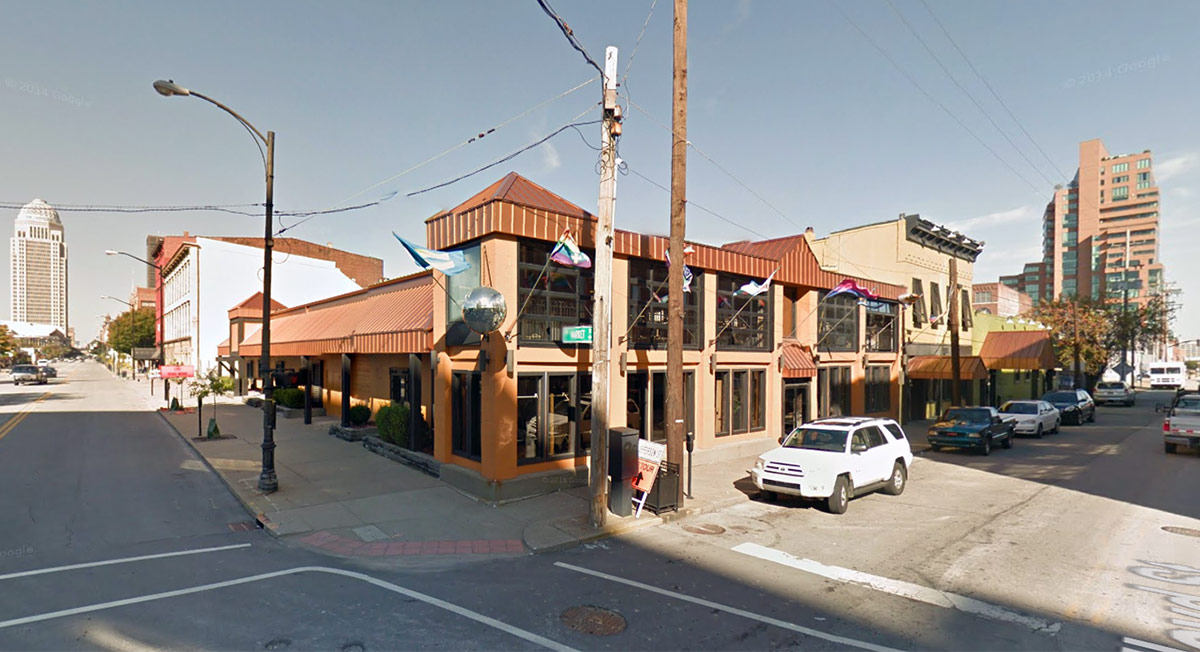
It’s happened again. Another commercial building on West Market Street in the Russell neighborhood hits the dust. I first began to worry about this building, most recently the Portland Bait & Tackle Shop slash A1 Batteries & Tires, back in 2008 after an attached townhouse was demolished leaving a hole in the side of the building.
The structure was crudely boarded up then and in disrepair but signs on the exterior indicated that the building was still salvageable. In December, I stopped by the structure again when visiting the demolition site of a brick mansion on the next block and noticed the city had declared the property an emergency demolition candidate. The boards over the windows, which were never fastened well, were gone and the hole in the side of the building was larger (although it looked like humans were making it bigger, not gravity).
A few days later, a tipster wrote in to say the building had been leveled. I stopped by one last time before my flight out of Louisville to document the rubble. This building might not have been ornate, but its vernacular character certainly contributed to what’s left of West Market Street. One by one, West Market Street is being undone.
One step forward and one step back in SoBro. The days are numbered for a romanesque gymnasium on Spalding University’s SoBro campus after an Intent to Demolish sign was posted in mid-December. The structure, dating to 1938, had previously served as as a gym for neighboring Presentation Academy but after a new Arts & Athletics Center was built on an adjacent block, the gymnasium was deemed surplus. Now, Spalding wants to replace the building with “green space.”
While the gymnasium is austere in detailing and simple in interior function, it provides significant urban mass and anchors the southern end of Library Lane at Breckinridge Street. Despite seemingly good intentions, destruction of the structure will profoundly degrade the urban environment around it. The building’s simplicity make it an obvious candidate for adaptive reuse.
Spalding’s Plans
Rick Barney, a University spokesman, says the gym may not be torn down until the Spring or later, but the building is already in imminent danger as half of the 30-day demolition moratorium for structures older than 60 years has expired. Barney says Spalding believes adding green space along Library Lane, an alley serving as a pedestrian spine connecting the University and the Main Branch Library, will improve the area.
No plan has been finalized for the green space plan, but Mike Ernst, Spalding’s Vice President and Chief Financial Officer, says the school is currently working with an architect and imagines the gym parcel will contain a gazebo-type structure in a park-like setting. Ernst says the University’s master plan calls for adding more green space in the future to create a more campus-like feel. He says the next phase currently calls for converting parking space on the south side of Breckinridge Street into a park and demolishing two more historic structures also south of Breckinridge.
In June of last year, Presentation Academy held a “farewell party” for the old gymnasium that had been part of its campus for 71 years. The structure had served as Presentation’s gym, theater, and was used for liturgies and gatherings up until last year and many artifacts from the building were auctioned off. Presentation’s Sister Chris Beckett said at the time that bricks would be salvaged and the gym’s old wooden floor would be used for fund-raising purposes. The property is now owned by Spalding after it assumed ownership of Presentation in 1995. Presentation began operating independently again in 2005 but the gym remained with Spalding.
Preservation in the Past
Spalding has had a contentious relationship with preservation in the past. Richard Jett, Historic Preservation Officer for Louisville Metro Planning & Design Services, says that because the structure sits outside the Old Louisville historic preservation district, there’s little that can be done to save the building without Spalding’s support. He lauds the University’s and Presentation’s commitment to their urban location when other schools have left for the suburbs but regrets the low priority of preservation apparent in Spalding’s master plan.
Jett remembers two recent Spalding demolitions that are now grassy lots. An Itallianate structure was torn down on Fourth Street between York and Breckinridge leaving only a set of stone stairs to mark the place of the old building. More significantly, an 1840s-era Greek-revival townhouse was destroyed directly across the street from the old gym and was believed by Jett to be one of the three oldest structures in the Downtown area along with a townhouse on Fifth Street (across from the Cathedral of the Assumption) and another recently restored townhouse on Second Street (next to the Episcopal Cathedral). At the time, some were suggesting the old house be converted into a coffee shop or similar use.
Marianne Zickuhr, Executive Director of Preservation Louisville, also laments the destruction of the old gym. She says while Spalding’s plan may bring more green space to SoBro, the idea is far from being “green.” Besides advocating for preservation of Louisville’s culture and history, Zickhur says it’s also the sustainable thing to do as there has been so much time and energy invested in building the structure. To tear down a sturdy building is to lose that investment. She also points to the economic benefits a possible renovation could bring to the community and the benefits of having historic structures on a college campus.
Tucked behind a more modern facade is one example of preservation already on Spalding’s campus. The University’s Administration Building surrounds the 851 Mansion, built in 1871 and designed by noted architect Henry Whitestone. The structure has been completely restored and is listed on Natrional Register of Historic Places and is a Kentucky landmark.
Too much open space in SoBro
There’s currently no need for more open space in the SoBro neighborhood. The diagram below shows SoBro surrounding the old gym (marked with a blue asterisk) and notes surface level parking in red and empty grass lots in orange. A quick glance demonstrates that what the area needs most is built environment. (Existing green space and parks are marked along with a green line indicating Library Lane.)
Patrick Piuma, Director of the Urban Design Studio, has spent a significant amount of time studying SoBro and working on the SoBro Neighborhood Plan. He says “the last thing SoBro needs is more empty space” and also regrets plans to demolish a structure that could be reused. Piuma says Library Lane is a defining feature of SoBro and the neighborhood plan calls for strengthening the pedestrian axis. He is quick to note, however, that Library Lane, like any public space, could be great only if properly designed and activated with uses that will draw people and encourage lingering.
Library Lane could serve as a pedestrian artery connecting the Main Branch Library at York Street with Memorial Park at Kentucky Street and serve as a defining element of University’s campus. Spalding’s campus is inherently urban in nature, a fact that should be celebrated, and as a result requires a more nuanced understanding of public space. A traditional building in the park approach such as at U of L simply won’t work.
The seeds of great green spaces already exist at Spalding and throughout the Library Lane corridor. The defining architectural characteristic of outdoor space on the block is the cloistered courtyard feel (see diagram below). There exists a procession of courtyard spaces each offering a distinct and intimate experience. Photos of many of the courtyards after the click. The gym in question helps to define two of the courtyards surrounding Spalding’s library and also serves to mark the entrance of Library Lane on Breckinridge Street.
Future potential of the gym
Inside, the gym is one large room. A gymnasium with a wooden stage at one end and not even enough room for bleachers. That certainly sounds like it’s no longer an ideal gym, and I agree. However, with a nearly 15,000 square foot area and tall ceiling heights that could accommodate a lofted second floor, the building is still big enough to be useful.
There are plenty of potential uses for the old gym ranging from classrooms, to a lecture hall, to a gathering space. One option I find intriguing is the potential to bring a third library to Library Lane by converting the structure into a modern library facility for Presentation Academy. A second floor could be added to the gym to accomodate additional space and portions of the northeast corner could be converted to glass walls to blend indoor study space with outdoor courtyard space.
This manipulation of the northern facade will be key in reusing the structure. Like most older buildings, the gym puts its best face to the street. The back facade is plain and some might say downright ugly. That’s where the potential to blend the old and the new to enhance both the building and the outdoor spaces reaches its full potential.
Save the old gym
It’s clear the opportunities for reuse exist even while funds or a clear vision might not currently be in place. The only thing required is saving the building from the wrecking ball. It’s understandable and laudable that Spalding wants to improve its urban campus, but to destroy the urban nature that makes it unique makes no sense. The old gym should be used creatively to strengthen the character of campus courtyards linked by a pedestrian alley instead of simply being removed for more open space in a neighborhood with too much flat open land.
Before the building is destroyed, a collaborative study (perhaps involving Spalding, the neighborhood, Metro Louisville, and the Free Public Library) should be undertaken to determine the full potential of Library Lane. We shouldn’t leave the burden only to Spalding as the feature stretches beyond its boundaries and affects more than its students. Activating the corridor will also require commercial investment outside the scope of Spalding University.
Existing park features such as Ben Washer Park and Memorial Park (designed, in part, by Spalding students) should be strengthened and can serve as well-defined park space anchoring the southern edge of SoBro. To the north, the Main Branch Library could serve as a green node and in between, pockets of green courtyards sheltered from wind and noise could accentuate the urban form.
But first, the old gym must not be demolished.
Click through for more photos of the gym and scenes along Library Lane.