The Rise and Fall of Butchertown
Broken Sidewalk Archives
If you can't find what you are looking for, try searching for it below:
The Rise and Fall of Butchertown
Early Monday morning at the Old Jail Building on Jefferson Square at about 8:30am, the Board of Zoning Adjustments will call the latest meeting concerning the JBS Swift Company to order. On the docket are several issues sparked initially by JBS Swift’s illegal construction project I reported on earlier this year. The story has been all over the news and it’s getting rather complicated, so I talked with Butchertown’s attorney Jon Salomon to figure out what’s really at stake.
The main issue at Monday’s BOZA meeting is the government mandated “revocation hearing” to determine if Swift’s Conditional Use Permit allowing the company to operate at its current site will be rescinded. The likelihood, however, that BOZA will shut down a company that employs around 1300 workers is very slim.
Also at stake is Swift’s ability to use a storage lot a few blocks from the main plant on Cabel Street. It currently leases the land from Metro Louisville. Butchertown residents had complained in the past that refrigerated diesel trucks were idling around the clock and suspected that they contained meat fresh from slaughter due to pungent odors, which would require another conditional use permit.
Storing Meat On Cabel Street
Butchertown and the City went back and forth over semantics for a while about the storage issue. It is legal to store “product” but not “meat.” That’s an important distinction as grocery stores and others store packaged meat “product” in trucks before it goes to market. Salomon released a letter on November 10 that indicates the neighborhood has documented workers spraying blood from the truck beds in the middle of the night which would indicate the stored materials were not a finished product.
While the storage issue may seem minor compared to the possibility of shutting the entire plant down, it does have long-term consequences for operating such a large industrial facility in the middle of the urban core of a major city. Butchertown Neighborhood Association president Andy Cornelius points out that the plant is currently landlocked and has nowhere to expand their facility, including storage.
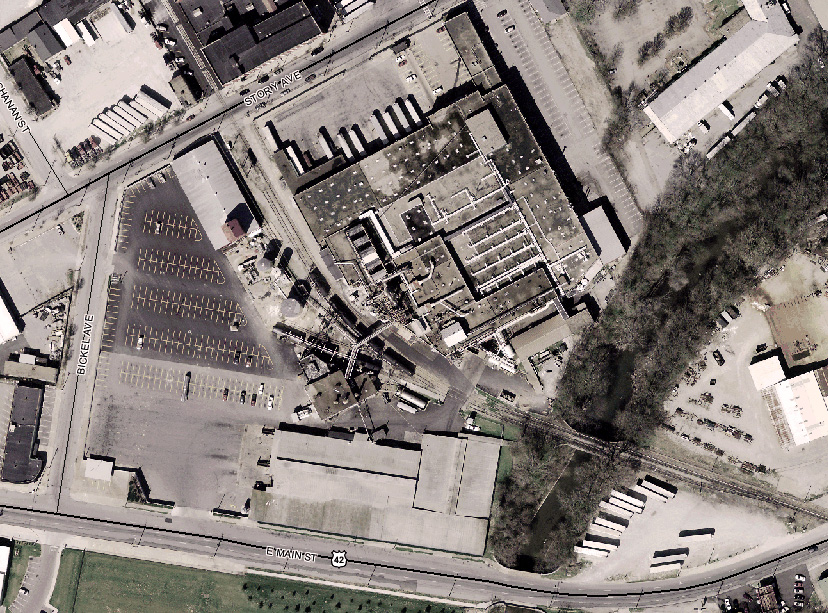
Mostly located on about 10 acres between Story Avenue and Main/Mellwood (excluding adjacent parking), there is little room for the company to expand and a production ceiling of slaughtering 10,600 pigs per day was already imposed by BOZA in September. This land crunch is why the company has been using about 10 acres of city land for storage. Jon Salomon calls the arrangement a “sweetheart deal” for JBS Swift as it only pays around $4,000 per year for the property. JBS Swift representatives earlier denied rumors that the company was considering a large expansion for its Louisville facility.
JBS Swift Workers Get Involved
In preparation for Monday’s BOZA meeting, workers from the JBS Swift plant have been distributing defamatory fliers about Butchertown residents and attorney Jon Salomon. On Sunday, workers marched through the neighborhood to show support for their jobs and JBS Swift. Many fear for their jobs if Swift’s conditional use permit is revoked.
It has been clear from the beginning of this ordeal that Salomon and Butchertown support the preservation of the jobs at JBS Swift. Salomon says the fliers are especially painful to him as he has repeatedly represented the interests of union workers and families throughout his career. Clearly no one in his or her right mind would wish the loss of such lucrative jobs in Louisville; the issue is about land use and a changing, dynamic city. Think relocation not loss.
The Ville-Voice reported on the fliers Friday that allege Salomon and the neighborhood are recklessly trying to destroy Swift jobs by running the company out of Louisville. Included in the material are references that the “greedy” neighborhood is out to get the workers who don’t fit into the “economic agenda” of a privileged few. There’s a failure to distinguish between the neighborhood’s opposition to a large, incompatible use and the jobs associated with it.
However, the workers’ concerns shouldn’t be dismissed out of hand. In light of the company’s decisions that created the current situation of uncertainty, it’s completely understandable the employees want to know what the future of their jobs may be. Jon Salomon says JBS Swift is solely in charge of the future of these jobs, “If we want to get serious about [job] security, let’s get serious about compliance” with the conditional use permit. Monday’s revocation hearing that could potentially shutter the factory is the making of the company itself.
New JBS Swift Lawsuit Could Delay Kenton Place Park
As I reported in September, as a mitigating element for illegally beginning a $560,000 expansion, BOZA required JBS Swift to contribute $137,000 toward public improvements around the neighborhood. Butchertown’s Capital Projects Committee unanimously decided the money should be put toward the construction of a lost Olmsted park, Kenton Place, on East Market Street.
In August, the Bingham Fellows, the community action arm of Leadership Louisville, proposed restoring the median-park first built in 1892 as one way to make Louisville’s fastest growing urban neighborhood more attractive to young professionals. After meeting with the Bingham Fellows, Butchertown’s leaders decided funding the park was a better use than other ideas such as building lattice-work around the Swift plant.
JBS Swift has now filed a lawsuit in circuit court to remove the mitigating elements from the conditional use permit in a move that shows disrespect to the Butchertown neighborhood and the Board of Zoning Adjustments. Andy Cornelius is disappointed with Swift’s follow through on the BOZA decision but isn’t entirely surprised. The move does show the company’s attitude toward engaging the community.
Butchertown Files Separate Lawsuit
Because of the handling of the entire Swift situation, Jon Salomon says Butchertown has launched its own lawsuit in circuit court claiming the neighborhood was denied due process. The suit says that BOZA was not notified of Swift’s violations in a timely manner resulting in unnecessary delays in the revocation hearing. The neighborhood is also upset over what it perceives as BOZA’s inadequate evaluations of conditional use permit revisions.
Salomon explains that a conditional use permit exists to codify a special use in a location where it normally wouldn’t be permitted under existing zoning. The idea is that the company or use must meet certain conditions or the permit can be revoked. The original conditional use permit was issued decades ago when the area was very different than today. The Bourbon Stockyards were still operating and Downtown Louisville’s current growth wasn’t even on the radar.
Goal Still To Relocate Facility
Moving the JBS Swift plant out of the urban core of Louisville has been discussed for decades. Jon Salomon says he realizes you can’t just pick up the factory and move it somewhere else overnight, but he would like to see a timeline set for retiring the current facility. Many in Butchertown have been hearing lots of talk and no action from the City over the years with no sign of real progress.
Most believe it’s only a matter of time before the plant is finally relocated. Salomon attributes some of the growth in Butchertown and in the East Market Street corridor to the expectation that the slaughterhouse, and its associated smells, won’t be there forever.
Rumors abound as to possible sites around the region that are being considered for JBS Swift, but uncertainty prevails. Whatever happens at Monday’s BOZA meeting, it’s important to keep a clear mind and focus on the primary issue at stake: land use in a growing urban core. Louisville must understand that the workers and the neighborhood are not at odds, but also come to see that the plant doesn’t fit in its current location any longer and must one day find a new home in Louisville.
Related Articles From Broken Sidewalk
At the end of August, an epic ten-hour hearing before the Board of Zoning Adjustments (BOZA) concluded that JBS Swift could continue operating in Butchertown after illegally beginning construction on a $560,000 expansion project. Several restrictions were applied to the slaughterhouse and an aesthetic budget imposed. What does all of this mean for the Butchertown neighborhood? I recently had a chance to talk with Butchertown Neighborhood Association president Andy Cornelius about the implications of the BOZA decision on the neighborhood.
Cornelius says the importance of the ruling is that BOZA actually made a stand on the issue and acknowledged that JBS Swift was in the wrong. While BOZA did not terminate Swift’s conditional use permit for the violations, they did put several restrictions on the business, limited its expansion of slaughtering capabilities, and required the company to have a hearing before BOZA for any future expansions.
This is good news for Butchertown, Cornelius says, as JBS Swift has gone unchecked by BOZA since its last conditional use permit hearing in the 1980s, 29 years ago. A substantial neighborhood audience weathered the long BOZA meeting to show their support of some kind of action.
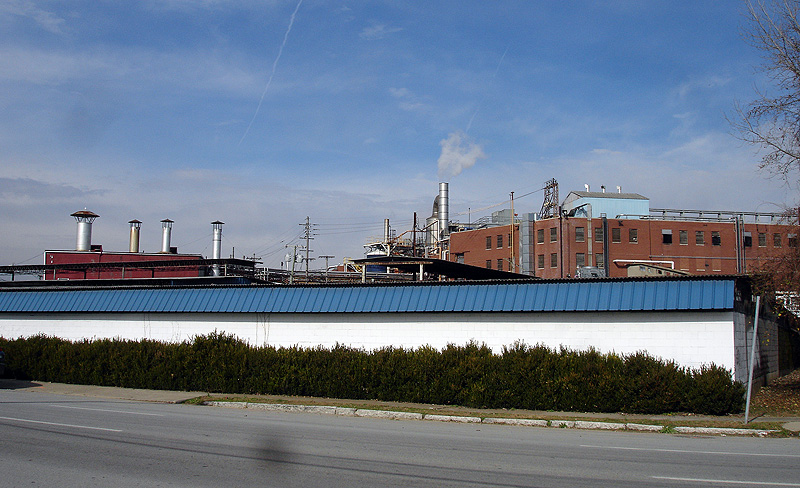
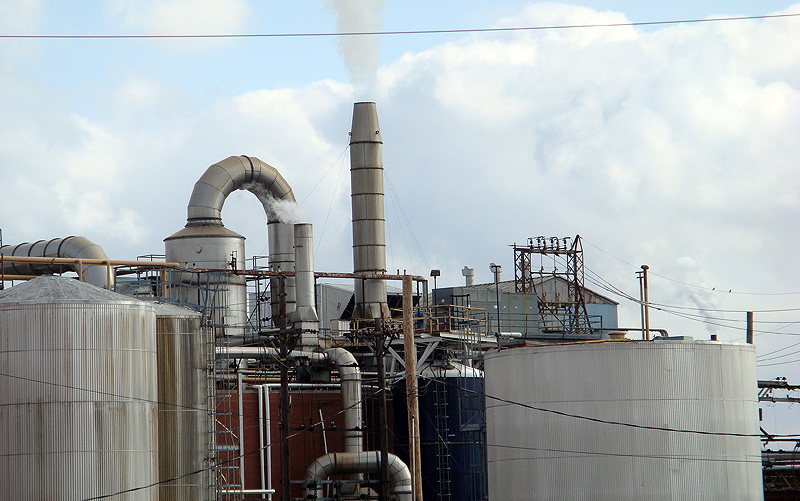
An illegal construction project sparked this latest round of neighborhood vs. Swift tensions. JBS Swift failed to obtain a building permit for a hog-chute enclosure expected to reduce odors off Mellwood Avenue (pictured above). A $500 fine was earlier assessed to Swift to correct the permit problem. Swift also plans a $1.5 million expansion to its boiler building to replace a broken steam generator.
BOZA’s solution pleases the Butchertown neighborhood. The expansion project was 25% complete by the time it was halted. Instead of requiring Swift to tear down what was built, valued at $137,000, BOZA requested the slaughterhouse provide the same amount in aesthetic improvements as a mitigating element to the area around the plant and the neighborhood.
While Butchertown’s lawyer Jon Solomon had compared such a measure to “putting lipstick on a pig,” Cornelius believes the hardscape and landscape improvements in the area will go a long way. Swift must work in partnership with the neighborhood and city planning officials to determine the funds’ best uses and locations. Swift’s lawyer has mentioned the company may appeal any landscaping obligations, but has made no move to do so yet.
The real importance of the BOZA decision is found in the restrictions on Swift’s conditional use permit. A production ceiling has been set for the JBS Swift facility. BOZA imposed a 10,600 pigs per day slaughter rolling average over six days. That’s above the federal limit of just over 10,100 pigs per day, but Cornelius explains that the BOZA number allows for days of higher and lower production to be averaged out. The 10,600 number, though, effectively prevents a two-shift slaughter operation that would run around the clock and holds production to current levels.
Overall, Cornelius believes a precedent has been set. He says Swift probably won’t be in Butchertown forever, as the city continues its search for a suitable relocation spot in Jefferson County, but the BOZA decision definitely made headway for the neighborhood. Further, Cornelius says the ruling is a victory for all in Louisville who were skeptical at the efficacy of BOZA to take a stand on an important issue.
The controversy isn’t completely settled yet. An upcoming BOZA meeting will address another contentious point in the neighborhood-slaughterhouse relationship: storing meet in refrigerated trucks on a city owned parking lot. That issue seems to revolve around the semantic differences between “meat” and “product” under the law. We’ll have more info later.
Butchertown and the JB Swift Company have been fighting for a while over an illegal expansion to the pork slaughterhouse’s facility (among other things) between Story and Mellwood Avenues. The Board of Zoning Adjustments postponed a hearing about the case which involves a conditional use permit until August 31.
Now, the Ville-Voice reports that Butchertown found Swift diesel-powered trailers running all day and night on a lot it leases from the city and LG&E:
“The Butchertown Neighborhood Association has discovered that Swift is storing meat in refrigerated trailers across the street from the main plant, an activity it says consitutes a hazardous use. The BNA says Swift needs a conditional use permit to store meat on its Cabel lot (leased from the city and LG&E). Earlier this week, BNA attorney Jon Saloman sent a letter to Bill Schreck, the city’s director of codes and regulations, asking him to issue an immediate stop order and to levy fines against the company.”
The upcoming BOZA meeting is sure to be well-attended as Butchertown is hoping to relocate the facility notorious for its odors out of the urban core of the city.
Monday’s Board of Zoning Adjustments meeting concerning JB Swift’s late-in-the-game approval for their mostly built facility expansion has been extended to August 31 at 8:30am. In a normal meeting like Monday’s, each side is allotted 15 minutes for testimony, but because of the complicated nature of this important case, the BOZA members voted to dedicate an entire meeting to the important issue.
While it’s going to be difficult to wait nearly two more months to hear a decision on one of the biggest concerns facing Louisville today, it does appear the BOZA is attempting to give the issue due concern. This decision, whether it sets in motion the relocation process for Swift or it continues down the same road of expanded facilities at the current Butchertown site, will profoundly impact the development and growth of Louisville for decades to come. It’s important this one doesn’t get screwed up.
Both sides submitted lengthy documents to the Board already, and each has been given extra time to prepare more material for the upcoming meeting. We’ll keep you posted when we learn more. Meanwhile, stay caught up with previous coverage of the ongoing situation:
Monday morning, JB Swift will appear before the Metro Louisville Board of Zoning Adjustments (BOZA) to beg forgiveness for illegally starting construction on an expansion to their plant in Butchertown. Swift needs a modified Conditional Use Permit (CUP) to operate at the site and continue with their expansion. Needless to say, the Butchertown Neighborhood Association will be there to fight for the communities surrounding the facility.
According to the Ville-Voice, the Butchertown Neighborhood Association has drafted a 16-page “prehearing statement” of opposition to Swift’s approval. All the gory details are there and nothing is spared. Butchertown presents three arguments in their case: the neighborhood has changed dramatically in past decades, the expansion is inconsistent with the neighborhood plan adopted as part of the city’s Cornerstone 2020 comprehensive plan, and that the company has demonstrated “bad faith and unlawful conduct” in their expansion efforts.
Butchertown’s statement suggests the plant would be better located in another part of Jefferson County where it’s not incompatible with its surroundings and notes that a “sophisticated multinational corporation” such as JB Swift has behaved as if ignoring local law and regulation and paying the applicable yet paltry fines is just the “cost of doing business.” The $47,800 fine paid by Swift last year for several years of violations probably goes unnoticed at a company that earned $1.5 Billion last year.
The statement notes the original conditional use permit was granted in 1969 when the Bourbon Stockyards directly neighbored the site (where the Home of the Innocents is today) with a staff report indicating that approval was granted “for the use as it now exists” and “increases in size of the present use, or alteration of existing uses or structures will need additional approval.”
The document then moves on to detail what it is exactly we’re smelling in the air in neighborhoods surrounding the plant and the foul problems of incompatibility that have become apparent with a revitalizing urban core:
“[T]he communities neighboring the Story Avenue Facilities have been subjected to a steadily increasing barrage of horrific odors, spills and sounds resulting from JBS/Swift’s dramatic expansion of its operations. These gross nuisances have included the overpowering stench of pig feces, urine, vomit, rotting pig carcasses, souring pig blood, other decaying animal byproducts, boiling and burning animal remains (including heads, feet, hair, entrails, blood and other body parts) and chemical agents such as chlorine dioxide”
If that’s not bad enough, the report goes on to describe what’s left strewn on on our local roads around the plant and left to decay or wash into local waterways from slaughtering “nearly 4.7 million pigs” a year in the heart of Louisville.
And we’re only to page six! It doesn’t get any better from there, although a little less grotesque. (Read the full statement from Butchertown over here [Warning: PDF].)
Luckily the neighborhood has garnered the support of Metro Councilman David Tandy who has drafted his own letter in support of relocating the JB Swift facility. He begins with the obligatory “keep the jobs in Louisville” and continues on to push the concerns of the neighborhood (read Tandy’s full letter here).
“I am committed to working to retain JBS Swift and the jobs it currently provides and will create in the future in Louisville Metro for many years to come.
“With that being said, I am strongly in favor, however, of developing a plan that would move Swift out of the Historic Butchertown Neighborhood in the near future and into a suitable location within Jefferson County that will provide the space needed for its continued service to this community as a viable business, while at the same time amicably coexisting with the environment around it.
“As for the issue before you tomorrow regarding the expansion of JBS Swift, while I understand this issue is under your authority as a board and respect your final decision, I am disappointed with the way this matter has been handled. In my opinion the neighborhood association and BOZA were not involved or notified in an appropriate manner.
“I respectfully ask that as the Board moves forward with this matter that the thoughts and opinions of the citizens that call Butchertown home be given your full attention and consideration.”
This seems to be the decision time on whether the JB Swift plant will ever be relocated. Company-neighborhood relations are at an all time low and now Swift has been caught building an illegal expansion that could prove to be the straw that broke the camels back. City officials have already endorsed the relocation effort and last year suggested that it could happen within five year’s time, but if we don’t hear something dramatic out of the BOZA meeting, when will another chance to relocate the plant and transform Louisville’s near-Downtown neighborhoods in such a dramatic way present itself? Stay tuned for more.
More Bitchertown vs. Swift coverage from Broken Sidewalk:
The JB Swift plant between Story & Mellwood Avenues in Butchertown had begun a construction project earlier this year illegally without a permit. The construction site was shut down after the city took notice, and a hearing was eventually set after much wrangling for last night. We didn’t make it to the meeting but the Butchertown Blog has a good wrap-up of the events:
“At tonight’s JBS Swift’s neighborhood meeting at Hall Cafeteria, both the plant engineer and general managers admitted that “mistakes were made” in the way they went about expanding their facility. They also acknowledged that the structure they are using to unload the live pigs has not been inspected by city officials, which poses potential hazards for their workers who unload between 15,000 to 16,500 pigs per day. Those numbers seemed to exceed the maximum production rate they are allowed at 10,000 per day, but further investigation is required to determine that.”
The meeting took place across the street from the Swift plant and reportedly around 50 people showed up. It was arranged as part of a requirement to get Swift’s conditional use permit changed to allow the expansion. According to the C-J, Swift claims this is all a misunderstanding:
“Swift plant engineer Keith Strunk and general manager John Cliff said the company mistakenly started work last fall on the animal chute without approval for the modified conditional use permit, thinking the contractor for the work had obtained the necessary approval.”
The reaction from the neighborhood was apparently one of skepticism about the company’s interests. According to Fox 41:
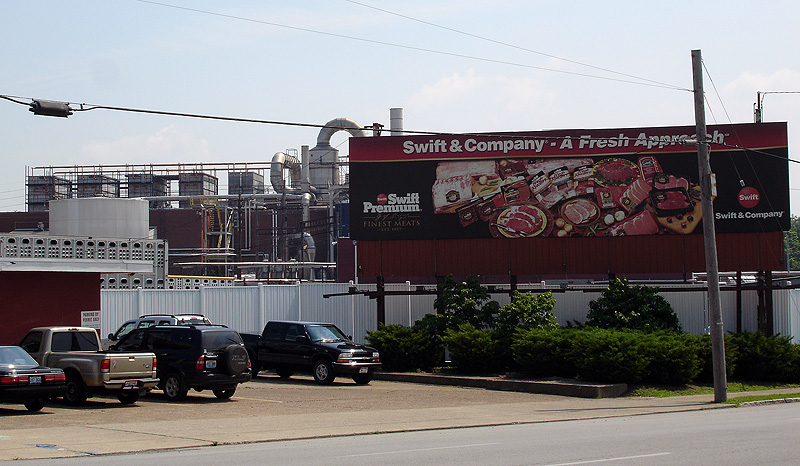
Their billboard on Mellwood Avenue says, “Swift, a company with a fresh approach”, but their approach was less than acceptable Tuesday night.
After their meeting with concerned neighbors on Story Avenue, John Cliff, the general manager, Keith Strunk the plant engineer, and Swift attorneys refused comment to about the neighbors concerns.
“They did admit to having made a mistake, but seem to think like everything else, there should be no consequences to those mistakes. What consequences do you think there should be for not going through the permit procedure? The land development code sets forth those consequences and they include revocation of the company’s existing conditional use permit,” said Jonathan Salomon, who is representing neighbors.
The neighborhood questioned whether any sort of aesthetic shielding had been considered to allow the plant to better fit into the neighborhood and Swift said it in fact had not. In the end, though, a decorative facade on the Swift plant would be like putting lipstick on a pig.
The JB Swift Plant between Story and Mellwood Avenues in Butchertown is ready to expand. So ready, a tipster tells us, that construction has begun without approval or apparently even a permit. An unpublicized meeting with the Metro Board of Zoning was held yesterday where the Board decided to delay approval for the already-started project until a public hearing could be held.
In all, Swift proposes adding about 6,000 square feet to its facilities including an “Unloading Chute” to deliver pigs to their holding pens. The concrete work above is the beginning of the new chute that will eventually be covered in metal according to plans filed with the city. It’s unclear at this point whether the additions are part of requirements put in place by the Air Pollution Control Board or for some other purpose, but the fact that they began construction without permission and then tried to get permission under the radar of the public and the Butchertown neighborhood shows what kind of neighbor the Swift Plant really is.