
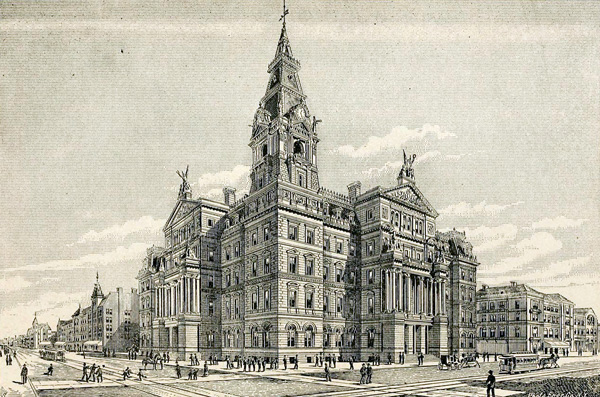
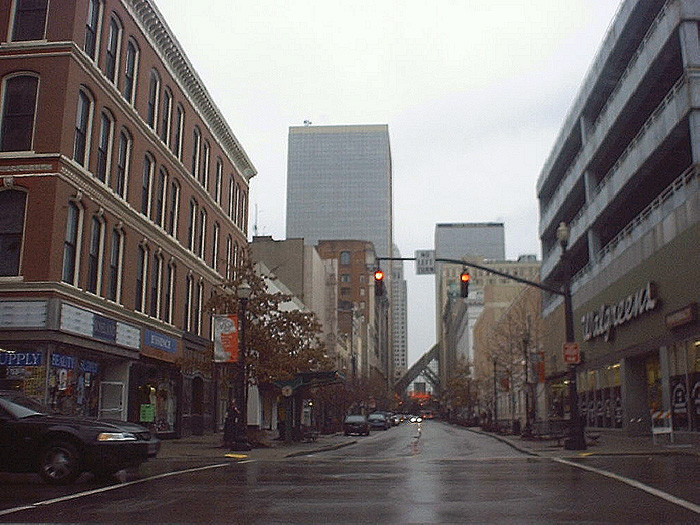
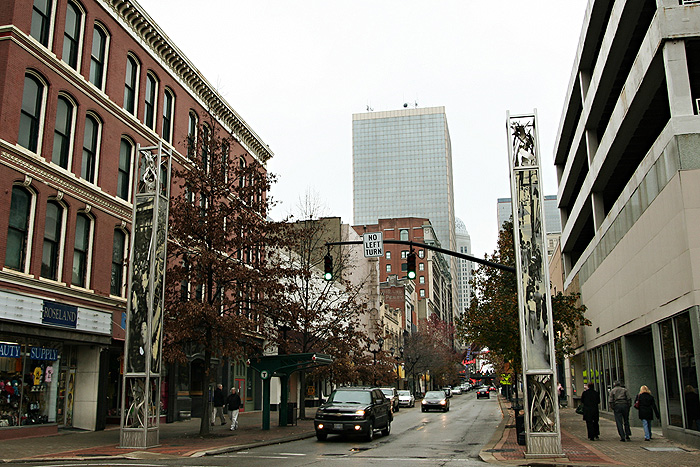
There’s been a lot of news lately about the corner of Fourth and Chestnut Streets as Bill Weyland and City Properties Group announced plans to renovate the old Caperton Block and build a parking garage with a boutique hotel and apartments. What makes these announcements so exciting is that the current state of this intersection is, to put it lightly, lacking. That wasn’t always the case, however, as the corner was once among the most grand in Louisville.
The loss of important buildings at this intersection has been tremendous and is one of the reasons why I advocate for historic preservation. It’s hard to imagine what the city was thinking when these buildings were deemed worthy of the wrecking ball. They are forever lost but should provide valuable lessons on why we should value our past. Imagine how much easier it would be today to revitalize Downtown is we had only a few of these buildings back.
Pictured in the engraving above (and in photos after the click) is the old U.S. Post Office and Customs House built in 1892 on the northeast corner. The absolutely monumental stone structure marked a trend of businesses expanding from Main and Market Streets into the largely residential area to the south. The Renaissance Revival structure contained one of Louisville’s first atriums that served as the site to many events.
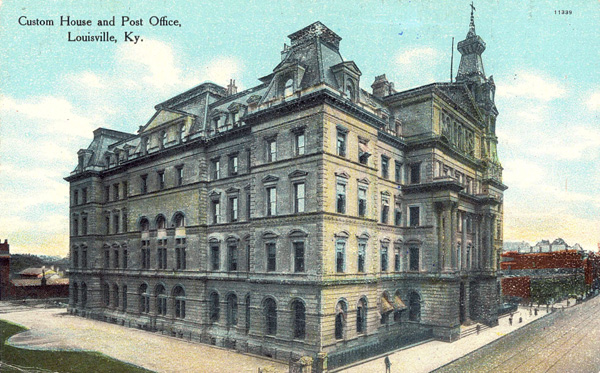
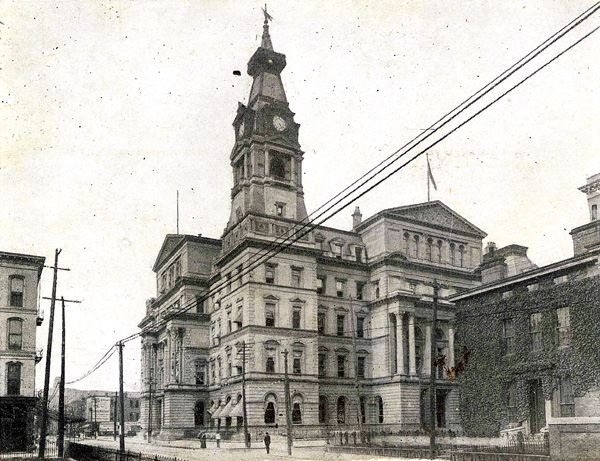
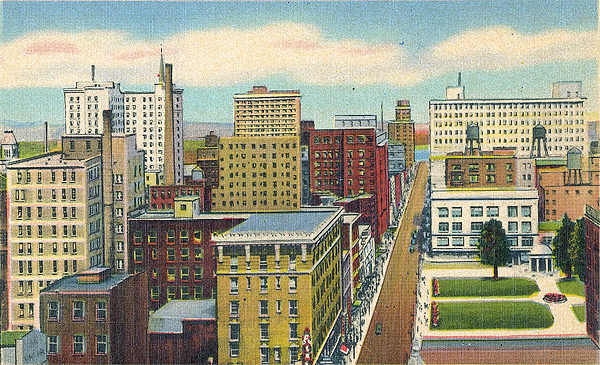

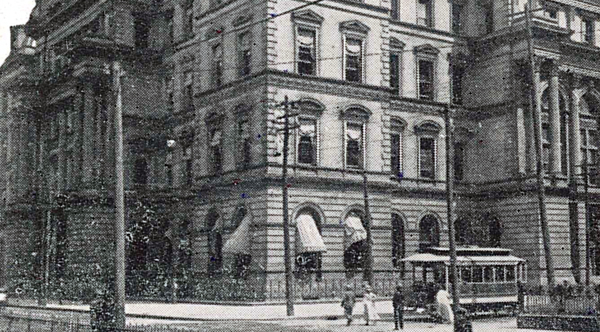
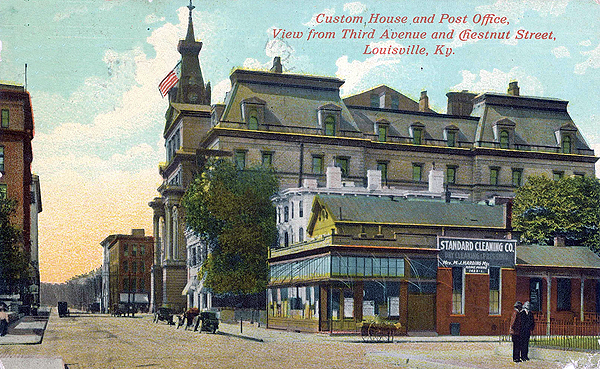

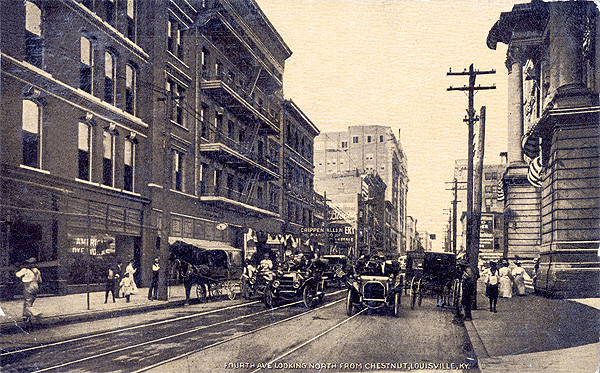
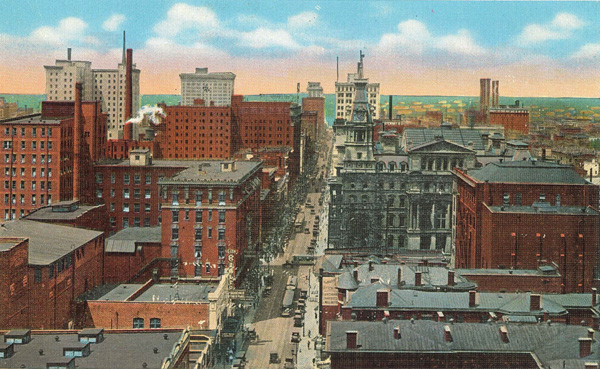
In my own opinion, this was the finest building in Louisville ever to be demolished (and really one of the best ever built) and it’s a little depressing every time I see a photo of it. According to the book Louisville by John Findling, the structure was abandoned in 1933 when a new facility, still standing, was built at 6th and West Broadway. After sitting vacant for a decade, the structure was demolished in 1943. Some in the community decried the demolition instead proposing a cultural center or museum but the majority of Louisville considered the building an eyesore and home to pesky starlings and pigeons.
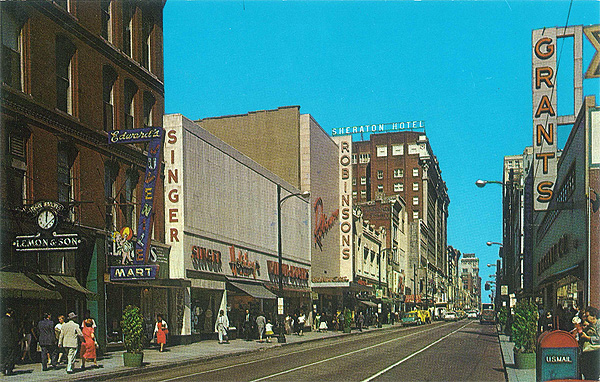
Demolition cost $100 and supplied “more than 9 million tons of iron and steel, 80,000 pounds of copper, 20,000 pounds of brass and bronze, and 20,000 pounds of lead” for World War II. If you can bear it, check out a couple photos of the demolition underway here and here. The site was briefly converted into Lincoln Park but was again cleared in 1950 and redeveloped into a JC Penney and Grants department stores and a parking garage which still stand today on the site and are currently for sale.
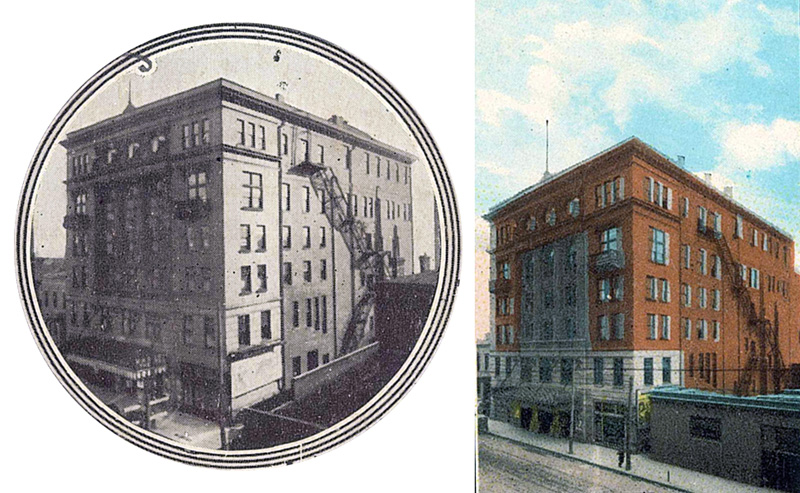
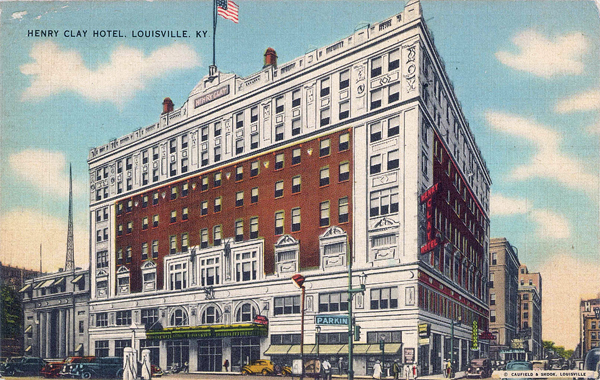
If that’s not bad enough, the grand 2,000 seat Masonic Theater also was on this intersection just off the corner next to the Henry Clay (photos after the click). The massive theater opened in 1902 as a stage theater and was the site of the first true talking motion picture in the 1920s. The theater was designed by the firm of Dodd & Dodd and was also known as the Shubert and later the Strand. Operations closed in 1952 and it was demolished for a parking lot in 1956. Check out a view of the auditorium and a view of its demolition.
One report of the opening night at the Masonic Theater read, “It was a scene to dazzle and to please. It was a theater to be proud of. It was enough to make not only the builder’s glad, but to send the people generally into enthusiasm. Few in the South can compare with this Masonic in design, decoration, comfort and all the other things that make for a complete theater building.” (via Actors, Audiences, and Historic Theaters of Kentucky)
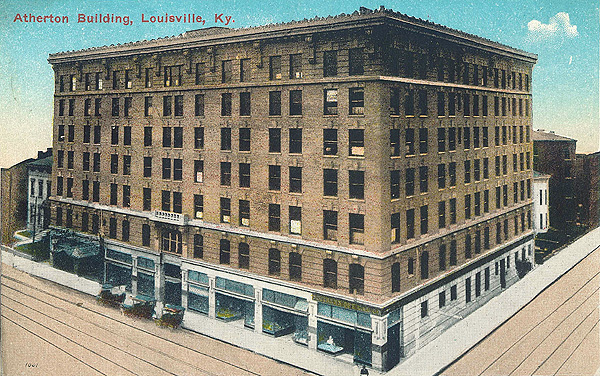
Many other large buildings were demolished in the area and the Atherton Building which housed the large Mary Anderson Theater has been substantially altered but still stands. Luckily, we have largely learned the error of our ways but it’s unfortunate we had to lose so much along the way.


I feel sick
There are people alive today who still feel the same way when they watched it razed…
Yes, those demolition photos make me want to cry…
The Masonic Theater was one of the places that made yelling “Fire” in a crowded theater a bad idea. On October 22, 1904, The nitrate film in a movie projector (not an Edison model) exploded and caught fire. In the melee to escape, a number of people were severely injured. Still, change in attitudes toward public safety would not take place for several years until after 1907 when the US averaged nearly seven theater fires a week.
“don’t it always seem to go
That you don’t know what you’ve got
Till it’s gone
They paved paradise
And put up a parking lot”
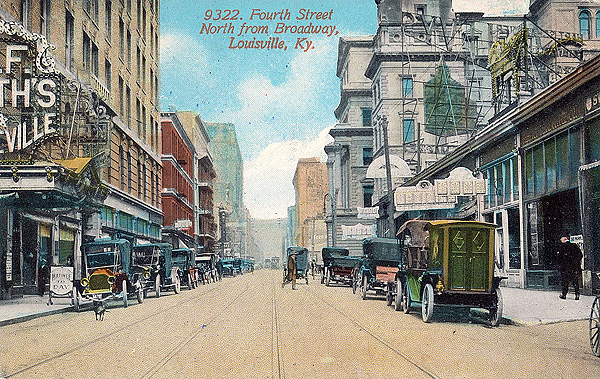
I’m not old enough to remember that post office, but I remember 4th Street when it still mattered. I remember the Memorial Auditorium, where Marion Anderson performed. I remember seeing the Modern Jazz Quartet there when I was about 15. Fourth Street from Kentucky to Broadway was that auditorium, majestic churches, the wonderful main library – and a Cadillac showroom. From Broadway to Chestnut was a theatre district for first-run movies: the Ohio, Kentucky (they were sort of B-level movies), Loew’s (the Palace), the Rialto, the Marian Anderson: varying degrees of opulence. Also on that street, a wonderful bookstore, Readmore, and Shackleton’s Music… and the Blue Boar, a great cafeteria.
4th and Chestnut was a a kind of jewelry district – Will Sales and Lemon’s, but also a big drug store (SE corner of 4ht and Chestnut).
The interesting thing to me in memory is that the stretch from Chestnut to just beyond Guthrie was always sort of second-rate compared to North and South of it: Grant’s was a kind of early K-Mart. Families always did classy Christmas shopping at Stewart’s (4th and then Walnut), Selman’s, Kaufman’s – all from Walnut to Jefferson. After Jeff, it became wholesaley, and dubious. Liberty News, on Liberty, was the only place I could find DownBeat magazine (when you’re a white mid-teen jazz fan in the fifties and sixties in Louisville, you have to make do in a number of ways)… and I could also sneak a peak at girlie mags there. Shops that catered to African-Americans were down around there… places I thought were cool, but, hey, I was a white teenager from the Highlands…
Fourth Street WAS Louisville 50 years ago…
The sub-urbanites decided that St. Matthews and the Summit are where they want to do their fancy shopping and movie viewing now.
For a good sense of scale of the Old Post Office check out this pic…
http://oldlouisville.com/Ruins/PO/PO1920.htm
I am one of the younger Louisvilians, so I grew up completely ignorant of my hometown’s grand architectural past (and in this case, ignorance is truly bliss). When I stumbled upon the website that David provides a link to, I was completely stunned, and nearly wept when I saw just how much had been lost over the years. Louisville used to truly be one of the great cities of this country, but no longer thanks to some idiot bureaucrat who thought that clear-cutting downtown was sound urban planning. However, I also think that we have little reason to despair; this city isn’t dead yet, and there still plenty of good building stock out there that needs saving. If there is one thing that I am certain about, it’s that Louisville has a VERY bright future (as long as those damn bridges aren’t built, anyway). I am saying that we should forget the events of the last century and move on? Absolutely not; those who forget the past are doomed to repeat it, as the old saying goes. What I am saying is that we should stop sadly dwelling on what was, and start imagining what could be. We can’t replace these grand monuments; it is doubtful that mankind will ever build with such grandeur again. But what we can replace is their function: the scale they lent to the street, and the homes, restaurants, and offices they contained. This city was great once, and it WILL be great again.
Amen Porter. We need to start moving past the talk of Louisville being a great city and start doing! This starts by looking at what we have now and proposing real solutions to address the reestablishment of street walls and significant vacant and underutilized corners throughout the city, both from a built environment standpoint as well as an economic view.
What do these areas need, how can we brand locations like SoBro and breath life into neighborhoods whose character has been lost by wholesale leveling? We also need to strengthen parts of our city that are successful as well. I drove around town with a member of DPZ several months ago showing some of the great places in Louisville. When we drove down Bardstown Road he was amazed that we had such an extensive commercial corridor that most cities could only hope for. He noted that by filling in some of the missing teeth could put the area over the top.
I think with the right leadership, Louisville could catch up and surpass our peer cities. While cities like Cincinnati are embracing lightrail and street car systems, we have been bogged down by the bridges. Though I don’t think that the bridges idea as is is a good idea, we cannot let that be the only discussion. Louisville has many assets and whether the bridges project moves forward or not, we cannot forget about the rest of the possibilities that are out there around our city.
If both bridges/spaghetti monster are built you can forget light-rail/streetcars for the next 50 years.
The Majestic Theatre is another 4th Street treasure that has since been lost to us. Just check out the exterior!
http://digital.library.louisville.edu/cdm4/item_viewer.php?CISOROOT=/kyimages&CISOPTR=124&CISOBOX=1&REC=3
The site showing the ruins of Louisville is so sad. I remember going to places like the Ford Mansion when I was a little one with my sister who took ballet lessons at the YWCA. The beauty of places like the Rialto theater are gone and lost forever. Going to movies there was a big time. Not like the cineplexes of today. All the marble and chandeliers. Downtown was the happening place. I was fortunate to have worked in the Commonwealth building before it was torn down. Going to work downtown every day was one of the best times of my life. Such a special place and I miss it dearly. No amount of new construction can ever replace what we had. So sad!
Steve
@Steve – What’s worse is that my generation (I’m currently 21) will grow up never knowing that our quiet little city was once a bustling metropolis. Louisville of the mid-20th century was such a completely different place that it almost makes me want to weep. Weep, because I know that I’ll never get to experience it. I can’t imagine what must have been like to see Louisville become the “city” that it is today.
@Steve – Ironically, both the US Custom House featured here and the Ford Residence / YMCA building you mention are related: Henry Whitestone designed the Ford Residence on Broadway; his predecessor, D.X. Murphy, was the supervising architect for the US Custom House building…both very sad to see replaced by forgettable eyesores.
@GBucko – ‘Scuse me: DX Murphy was Whitestone’s SUCCESSOR…
This just shows that we should go back to some of the more intricate Architecture of the past because every step we take away gets less creative, I would like to see a mixture of the Modern Glass with Historic Cast iron and stone. And for God’s sake pleas stop tearing down History.
You can’t be serious, what would make someone destroy this? I guess they didn’t know how plain and boring the future would be, they must have thought someone would put up an equally intricate building.@Porter Stevens –
(Directed towards William Huston and others wondering how beautiful old architecture could be wantonly torn down.)
You have to understand the mentality of the era (not that I really do myself): when these buildings were demolished, they weren’t considered historic. Rather, they were just old enough to be “fussy”, “old-fashioned”, and “devalued”. The architecture of the 1880s to early 1900s was viewed in much the same light as many people view the post-WW2 Atomic Ranch style today. In other words, not old enough to be historically interesting, just old.
Now, lest you think that I’m defending that mindset, I am emphatically not doing so. In fact, it makes me rather sick to my stomach. My mom and dad were on the forefront of the renovation trend in Old Louisville in the early 70s, and I am proud to say that Mom took on the FHA to get the first renovation loan that the agency had granted in the neighborhood in 50 years. One of the books that Mom still has details all of the buildings that were lost to post-war urban “renewal”. It’s heartbreaking to see what we lost, and are still losing.
Even though we’ve long moved out of state, Louisville is still home. Even living halfway across the country in Denver, I keep an eye on the places where I grew up. It grieves me to know that I won’t be able to show my husband many of the landmarks of my youth and childhood. It grieves me even more that the active and determined historic preservation movement that I remember (from back when Harvey Sloane was mayor) seems to have lost momentum.
This may be my ignorance, but were all the numbered streets such as Third Street called Avenues at one time. There is a postcard that refers to The Post Office and Customs building being viewed from the corner of Third Avenue and Chestnut Street.
@Patrick – Yes, they were referred to as Avenues at one point. You can see it in the names of places like Third Avenue Baptist Church and what used to be Fourth Avenue Baptist Church (now Louisville Church of Christ) in Old Louisville.
This site indicates Old Louisville addresses were renumbered in 1909, so maybe that’s when it changed.
@Jeff – Thanks for the clarity and link. And I always thought that Third Avenue Cafe was just trying to be crafty with their name.
Comments are closed.