Broken Sidewalk Archives
If you can't find what you are looking for, try searching for it below:
A collection of colorful birds, ducks, and roosters by folk-artist Marvin Finn (1913-2007) arrived back at Waterfront Park today near the corner of Preston and Witherspoon Streets. The public art display of 29 birds had been undergoing restoration involving repairing chipped paint. The total project cost $5,000 and was funded by an endowment set up for the art collection. While individually the birds are quite small, interacting with the flock en masse is quite a whimsical experience, and we’re glad to see the sculptures back in their rightful home.
Waterfront Park’s Great Lawn is losing a couple hundred square feet of grass underneath Interstate 64. But first, let’s take a moment to gaze upon Louisville’s beautiful skyline. It’s all there in the photo above. Waterfront Park Place is on the left, the Aegon Tower and National City Tower looking elegant in the center, and the Galt House and Arena site on the right. Not many cities can boast a skyline that’s well… a line. And for that, Louisville should be proud. We should include this view of our skyline from our beautiful Waterfront Park in our marketing endeavors. Let’s make some post cards to send to all our friend’s to tell them how swell a place this is. We may not have power, but at least we can drive right through one of America’s best parks. And our skyline is growing, too! If we do ever build Museum Plaza, it will interrupt the clean lines of our city, so we’re expanding the skyline by about 75 feet. That’s roughly to the shadow line in the photo, we estimate. That should be enough to hide even the tallest building anyone can dream up.
8664.org wants to tear down our beloved skyline. They even found some scientists over at Scientific American to back up their story with quotes like: “closing a highway–that is, reducing network capacity–improves the system’s effectiveness.” What are they thinking? Where else can we go for shade on a sunny day? Trees are a thing of the past; nothing says Welcome to Louisville like the harsh clanging of metal and guzzling of big-rigs. Here’s more from the Scientific American article:
“Conventional traffic engineering assumes that given no increase in vehicles, more roads mean less congestion. So when planners in Seoul tore down a six-lane highway a few years ago and replaced it with a five-mile-long park, many transportation professionals were surprised to learn that the city’s traffic flow had actually improved, instead of worsening. “People were freaking out,” recalls Anna Nagurney, a researcher at the University of Massachusetts Amherst, who studies computer and transportation networks. “It was like an inverse of Braess’s paradox.””
The article goes on and is well worth a read, but we’ve got a dying Waterfront Park on our hands as it seems that Interstate 64 isn’t a fan of grass. We first noticed the dirt being moved under the highway a couple weeks ago, but today the ground was being leveled to accept synthetic stone pavers and formwork for a new concrete curb set up. The area was perpetually muddy as grass couldn’t fully take root in the shadow of the elevated road. Torrential ponding of water runoff from the highway also causes erosion problems in the area. Now, we don’t have to worry about the grass… because there won’t be any. A few new trees were planted, though, to catch the meager rays of sun that penetrate through the concrete.
Stop Lite Wine and Spirits moved out of Waterfront Park and into a new store across River Road last November, but this week, crews demolished their old building from the 1950s. The spaced being cleared will one day be incorporated into Waterfront Park as green space, but for now, it will be paved for parking. The new Stop Lite Wine & Spirits location hopes to emphasize the cafe side of the business catering to hungry park-goers. A second retail location at the new building is still vacant and for lease.
Two giant steel tubes arrived at the construction site of Waterfront Park Phase III this week and will eventually be installed as piers to support the curving ramp that will one day lead pedestrians from the park to the bridge above. The columns will be set upright over the finished foundations and filled with rebar and concrete. The metal in the piers is similar to Core 10 steel which forms a naturally rusty outer layer intended to match the existing Big Four Bridge. Once complete, all the new steel for the ramp should match the aged patina of the old bridge. A contract has already been signed to install the ramp piers and work is expected to begin in January after all the piers arrive on site from Florida.
It always seemed a little strange a liquor store named Stop Lite was perched in one of the nation’s top urban parks at a location without a stop light. The unassuming building sitting in Waterfront Park is now vacant and a reminder of how much the area has changed from industrial wasteland to green parkland in a matter of years.
The familiar Stop Lite Liquors located on the eastern edge of Waterfront Park opened today in their new location across the street. Owners Carl & Jesse Bollinger built the new store at 1342 River Road and updated the official name of the business to StopLite Wine & Spirits, marking a sort of mini-gentrification brought on by the park. There’s also an expanded emphasis on StopLite’s Cafe operations. The Bollingers want their business to be a place where someone might grab a hot sandwhich or hotdog and enjoy eating in the park.
Another benefit of the new building is provision for a second retail outlet. What otherwise could have been a stand-alone business now is looking to add to the vibrancy of the park. 2,250 square feet are available for lease directly facing the Waterfront Park. We’re hoping it’s filled with a business park-goers could find useful.
The land underneath the old store has already been exchanged with the Waterfront Development Corporation, and David Karem, president of the WDC, notes in his OpEd over the weekend that demolition is imminent on the old building. The site will likely be converted to a grassy playing field for the time being, and with much of Phase III set to open next year, a continuous green park will stretch from downtown to near the foot of Frankfort Avenue in no time.
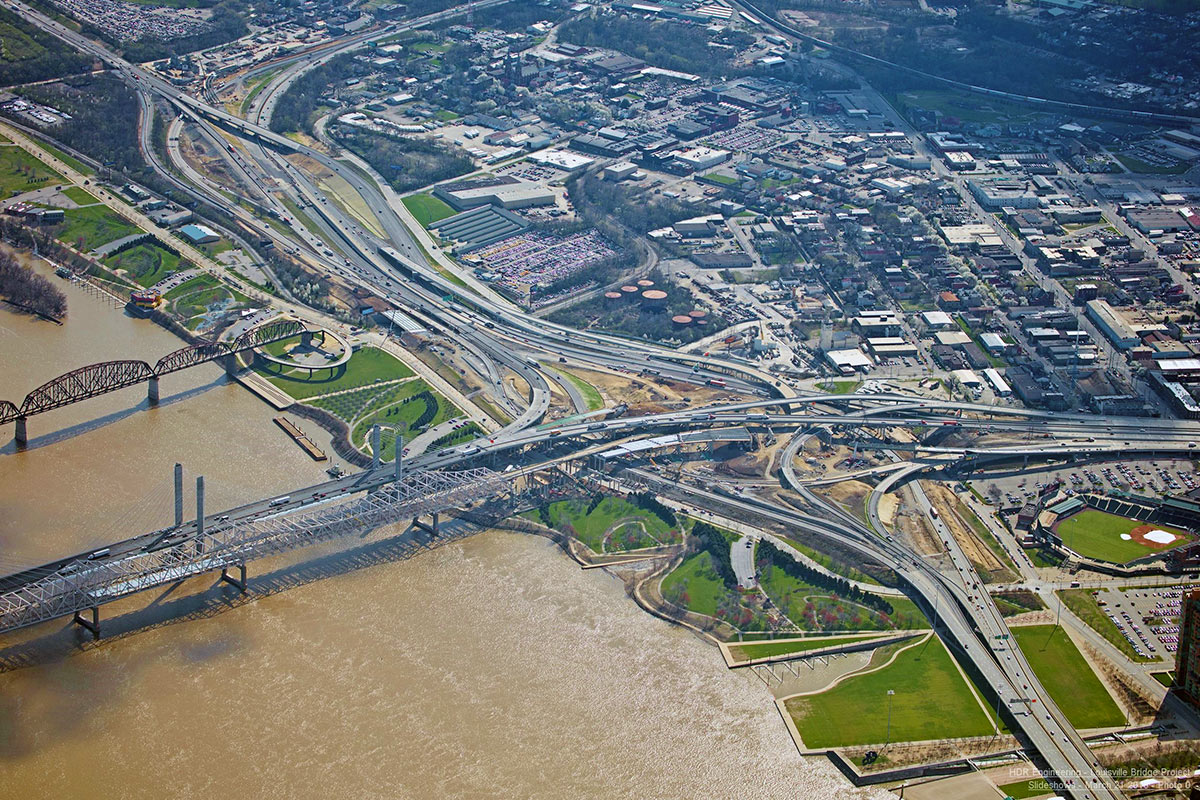
Waterfront Park has undoubtedly been a major boon to revitalizing Louisville’s urban neighborhoods, but the eastern and western phases of the park still remain divided by hundreds of feet of chain link fence as construction continues on some of the most dramatic features of the entire park system: the Big Four Bridge and the Lincoln Memorial. It’s been a long and arduous process to move from the industrial wasteland that once comprised Louisville’s waterfront to the nationally acclaimed park that exists now, but the wait has well been worth it. The final 13 acres of the 85 acre project are scheduled to be phased in over the next couple of years and will finally unite the park into one community jewel.
We took a tour of the estimated $22 million construction site as the grass is beginning to grow and the heavy construction is starting to heat up. Peering through the fence at the park’s signature sculpted hills reveals only a portion of the inner workings of the site. The articulation of the river’s edge is far in the distance and the Lincoln Memorial is all but hidden from view. Landscape architects Hargreaves & Associates of San Francisco have shown how skillfully they can articulate space in Phase I and II of the park, and one must experience the new spaces from all angles to appreciate their full complexity. Once within the confines of the construction fence, the true intricacy of the park begins to be made apparent.
Walking along the riverfront from the west, a granite amphitheater appears from behind a sculpted earthen berm. Next spring, a larger than life Abraham Lincoln will be perched atop a massive boulder intently gazing down the river. (His general glance will be fixed on the third pier of the Kennedy Bridge, we’re told.) The Lincoln Memorial has been designed to be an experiential journey past four bas reliefs depicting scenes of Lincoln’s life in Kentucky, wrapping around the gentle curve of the amphitheater until the visitor is confronted by the former president himself sculpted by renowned local artist Ed Hamilton. The surrounding berm shields the memorial from the rest of the park, essentially wrapping around the site and embracing the micro-landscape. According to the Waterfront Development Corporation, the Lincoln Memorial “teaches about his connections to Kentucky and about how, as a young man, he developed his abhorrence of slavery while standing on the banks of the Ohio River in Louisville.” The space has the potential to be a deeply moving one.
You’ll want to click through, there are dozens of park photos just ahead (and more to read!)
Today at the IdeaFestival, Studio Arne Quinze revealed their proposal for transforming the Big Four Bridge into a dynamic art installation weaving itself through the bridge’s iron trusses connecting Jeffersonville and Louisville. Quinze’s installation work is known for its unique construction of linear wooden sticks joined in an apparently chaotic but well informed manner to create large organic and fluid sculptures. The proposal includes solar panels incorporated into the design allowing for nighttime light-plays and music to emanate from the wooden cloud. During the day, the installation will filter sunlight to create the quality of light passing through leaves in a forest. ”It’s a huge project, but I believe in it and it will work,” Quinze said. ”Now the idea is in your camp… I make the idea and now you” must find a way to build it.”
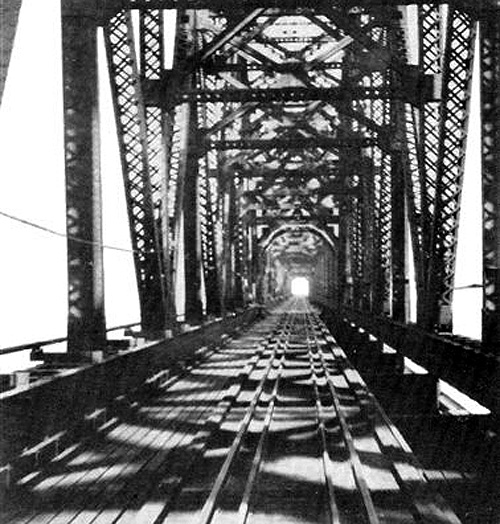
The Big Four Bridge is an abandoned railroad crossing and part of the final phase of Louisville’s Waterfront Park, designed by Hargreaves & Associates. The bridge, built in 1895, will be turned into a pedestrian walkway connecting Kentucky and Indiana. A dramatic sprialing ramp is being built to connect the bridge to ground level in the park. A smaller ramp is being built in Jeffersonville, Indiana. In May of this year, the bridge deck caught fire after an inspection due to faulty wiring of a light fixture. The wooden bridge deck was damaged but the structure was unharmed.
The announcement comes the day after Mark Beasley of public art firm Creative Time lectured to IdeaFestival crowds. Creative Time has just been hired by the City of Louisville’s Mayor’s Advisory Committee on Public Art (MACOPA) to draft a master plan to guide public art throughout the city.
In addition to the cloud sculpture, the proposal lays out a program for the pedestrian walkway of the Big Four Bridge. Quinze envisions a timeline running across the 2,525 foot long bridge detailing possible historical events important to the city’s growth. Earlier this month, DeLeon & Primmer Architecture Workshop revealed their Happy Birthday Pavillion that will sit beneath the bridge and its spiraling ramp.
Studio Arne Quinze has worked on a number of public art installations including Cityscape in Brussels Belgium, the Burning Man Pavillion in the deserts of Death Valley, and proposals for the Galactic Transporter for the Beijing Olympics and Rebirth Pavillion for the Champs Elysees in Paris.
This morning on the Great Lawn in Waterfront Park, we spotted yet another inflatable animal descending on downtown Louisville. This time, the giant cow turned out to be a hot air balloon participating in this weekend’s Bluegrass Balloon Festival at Bowman Field (formerly the Adam Matthews Balloon Festival). You might remember the IdeaFestival run-in with a giant inflatable cow on the Belvedere a couple year’s back brought in by West8 Landscape Studio from the Netherlands. Perhaps this is the beginning of an inflatable animal / IdeaFest tradition? Here’s some info about the event:
“The Louisville skyline will host a birthday party of gigantic proportions for the 10th anniversary of the Bluegrass Balloon Festival, September 26 – 28, 2008. The celebration includes a 90 foot Meijer birthday cake and Chuggles, the crowd-pleasing Dean’s Milk balloon! Pilots from across the United States and Canada will descend on Louisville for the largest event of its kind in Kentucky. The festival offers something for everyone from the mass ascension in the early morning light to the magical radiance of balloons aglow at night.”
Admission to the festival is $2 for walk-ins or $10 per vehicle and will benefit children’s charities. There’s a lot going on at the three-day event, so for a full schedule, go to the official site.